Monday, October 20, 2008

Bathing scenes


I read an excerpt from Kimberly Nee’s novel Eden's Pass which featured the heroine helping the hero with his bath. I enjoyed it, even though I hadn’t read anything else about the story or the characters, and that made me stop to think. In romance novels, the sex scenes can blend together after a while (especially if you’ve read too many of them). Bathing scenes are a good way to vary the pattern, and I like reading them in both romances and fantasy novels (Daughter of the Blood, Kushiel’s Dart).

Sexual tension can run high in bathing scenes if the focus isn’t on the characters having sex. Instead, it could be on one character actually bathing, while someone else watches, reluctantly assists or pretends to help while trying to seduce him or her. A man washing a woman’s hair (as long as she isn’t moaning as though she’s in a shampoo commercial) can be more erotic than the man going straight for the erogenous zones.

The sexual tension is always heightened if the characters are attracted to each other but don’t have sex, and bathing is a great way to skirt the edge of that without falling off. Even the props in such a scene could contribute to this. If the bathee is tensely waiting to feel skin against skin, feeling a pumice stone instead – moving slowly across his or her back – could be very arousing.

A tub or shower is also more conducive to seduction/sex than a lot of other places I’ve seen in romances – such beside a glacier and on horseback. The only bathing scene I’ve read that did not work at all was from an X-Files fanfic where Mulder and Scully decided to take a shower together on their honeymoon. Scully turned out to be obsessed with preserving her virginity and used the shower as a way to satisfy Mulder without having to endure the consummation. It was… strange, to say the least.

Other than that, though, I enjoy these scenes. Bathe on.

Saturday, October 18, 2008

All about blogs


I like blogs. They’re like an online newspaper, except geared to issues that I enjoy, and I enjoy being able to contribute something to my own small corner of the blogosphere.

I thought of having a website, but although a friend was kind enough to set up a site for my secret identity, the only way to transfer information from my hard drive to that site was to do something with “ftp”, and that gave me a headache. I confess: I am a computer illiterate. Blogs seemed as though they might be a little less challenging, and so far, this one has been. Write, post, check the Bare Bones Guide to HTML to figure out how to right-justify something, correct a typo. Even I can handle that.

Then there’s content. I like talking about writing (technically, writing about writing), and doing reviews. There are countless blogs which provide information and advice on different aspects of writing and the industry – insider viewpoints from agents like Miss Snark and Kristin Nelson and from editors and editorial assistants (if you haven’t yet read the story of Moonrat’s lunch with an author, check it out). I’d love to find blogs from other people in the industry, though – cover artists, slush pile readers, copyeditors, publicists. Publishing is fascinating.

Blogs from writers are just as much fun to read. I like tips and advice, but funny family stories are a welcome relaxation and make a personal connection between author and readers.

The only kind of blogs I don’t enjoy are those which are difficult to read (e.g. purple text on a black background) or those which are only or mainly about promotion of the author’s books – descriptions of the books, the latest reviews they got, where they can be bought or even the main characters from the books chatting with each other. Promotion is great, but there needs to be another reason for me to read the blog.

So, for my hundredth blog post, here is a post about blogs.

Now, back to writing.

Thursday, October 16, 2008

Five oddities in sex scenes


This isn’t necessarily a list of things I don’t want to read again, but it’s definitely a list of things that confuse me just a bit.

1. Lack of thought about pregnancy

Probably the best example of this is The Thorn Birds, where Meggie and Father Ralph (a Catholic priest) finally consummate their love and spend some time on a tropical island. That was fine, but Ralph doesn’t ever consider precautions. I suppose that was in line with his religion but if he was going to break a vow of celibacy, he might as well have used some form of protection too.

Needless to say, the inevitable happened. But when he discovered, years later, that Meggie had a child, he never once stopped to do the math. I have no idea why it didn’t occur to him that he could be a Father in more ways than one. He wasn’t that innocent.

2. Religion at the bedroom door

Speaking of religion, I’ve read two romance novels which featured characters who went to church each Sunday… but who had premarital sex anyway. I know some (or many) people reconcile the two, but I would have liked to see the reasoning behind how they did so.

3. Flat male nipples

Or “hard male nubs”. I think this is due to a fear of men’s nipples appearing too feminine if they don’t have the “male” adjective attached like a warning flag.

4. Quick-wick sheets

That’s the only explanation for the lack of any damp patches. This is even more strange if the woman has lost her virginity and then gone blithely to sleep on the same damp, stained bed linens. I think a man who stripped the bed and put clean dry sheets on before bundling me back into it would be a keeper, but maybe that’s just me.

5. Prettification of oral sex

The woman’s genitalia smell or taste like something dainty and aesthetic, like flowers. Unless she’s douched recently, this doesn’t seem likely. I’ve even read about heroines who taste like apples and honey, which make it sound as though they’ve got a picnic basket down there.

Monday, October 13, 2008

Ways to recognize a vanity press


Most authors these days know that paying to be published is a sure sign of vanity publication, where the only book that matters is the author's checkbook. So some vanity presses disguise what they are (e.g. by shifting fees to the back end) or come up with an array of reasons as to why it's necessary for an author to pay.

No matter how much smoke and mirrors are produced, though, there are several sure signs of a vanity press. If anything in the checklist applies, investigate further. Some of these are signs of amateur presses or inexperienced micro-publishers as well.

1. Fees

___ The publisher charges an upfront fee before the manuscript will be accepted
___ When questioned about this fee, the publisher responds that it is an investment or necessary contribution on the part of the author
___ The publisher charges for any other aspect of book production and marketing

2. Responsiveness

___ The publisher responds very quickly to manuscript submission, sometimes accepting the manuscript in under a week.

3. Types of manuscripts accepted from unpublished writers

___ Collections of poetry
___ Collections of short stories
___ Non-fiction from writers without a platform
___ Fiction of almost any length and all genres

4. Editing

___ Editing is minimal, often limited to a spellcheck
___ The author is given the option to have the book printed without editing
___ This is couched in positive terms such as the author having complete control over the process or the publisher not altering the author’s unique voice

5. Book covers

___ Authors are asked to write their own blurbs for the back covers. These do not receive editorial input

6. Reviews

___ The publisher does not send review copies out in advance of the book’s release
___ The publisher says it may send review copies out, provided reviewers request such copies
___ Authors routinely provide each other with positive feedback, which is accepted as a substitute for professional reviews

7. Sales of books

___ The publisher relies mostly or exclusively on POD
___ The publisher says that its distributors are Ingram and Baker & Taylor
___ The publisher assures authors that their books will be available on Amazon.com, Barnes and Noble.com and the publisher’s own online store, and this is presented as an adequate substitute for bookstores
___ The publisher offers discounts to authors if they buy their own books, but does not offer the same or better discounts to bookstores.
___ The publisher encourages authors to buy their own books, especially in bulk

8. Staff

___ The publisher does not make the previous relevant experience of its staff available
___ The publisher provides full names and bios of the staff, but they have no industry experience listed
___ Authors work for the publisher, e.g. reading slush

9. Publisher claims and achievements

___ The publisher claims membership in organizations whose requirements have nothing to do with the way authors are treated, e.g. the BBB, Mensa, etc.
___ The publisher claims to have signed up the largest number of previously unpublished authors, but says little or nothing about the number of books sold
___ The publisher’s advertising is geared to authors, e.g. making their dreams come true
___ The publisher refers to itself and its authors as a family
___ When asked whether it is a vanity press, the publisher responds that it is a traditional publisher, self-publisher, subsidy publisher or co-investment publisher


As long as you credit me for it, please feel free to share this checklist with anyone who might need it.

Saturday, October 11, 2008

I will rule the world!


Villains who want to conquer/destroy the world are only too common, but there are a few ways to make such an antagonist stand out from the crowd and be realistic.

1. Motivation

Why does your antagonist want to conquer or rule the entire world? Every generic Dark Lord wants to do this, certainly, but these days, characters need more motivation. Here are a few ideas:

Ideology: The gods have charged her with bringing the Message of Hope to the heathen masses, and she’ll have to conquer them to do it. Or else a new religion is rising in other lands, and she’s afraid it will contaminate her people if she doesn’t act fast.

Greed: Other lands have gold mines and forests of spice-trees.

Expectations: The antagonist is a general and the order comes from above. What can he do but obey it and invade other lands? Or an ancient prophecy says that he will be king hereafter over all the world – I wouldn’t mind seeing an antagonist’s ambitions spurred by that.

2. Control

Especially in a medieval fantasy, how does the evil emperor plan to control what will happen at the edges of his empire once he’s taken over the world? How does he know his underlings won’t plot against him or break away from his rule? If communication is patchy or slow over such long distances, how will he control the world once he defeats it?

Harry Harrison’s Deathworld 3 delivered a beautiful answer to those questions. The warlord Temujin, leader of a nomad army, defeated several cities, ruled the world… and realized he’d lost his people’s traditional way of life. His nomad army was now living in the cities they had conquered, enjoying culture and civilization and fine wine. Temujin’s life was battle and riding and living in tents, but suddenly that was the old way. It was unwanted now that his people had the world at their feet.

It may be easier to conquer the world than to control it.

3. Logistics

If the Dark Lord needs a million-strong army to conquer the world, he’ll need a corresponding number of smiths, armorers, cooks, farriers, physicians, scouts, prostitutes, etc. Such a large army will need plenty of food and water, meaning their supply lines can be disrupted, and diseases will be more likely to spread among them (unless the Dark Lord uses magic or his brains to overcome these obstacles).

The conquering of the world is also going to be affected by the weather and geography of wherever the army is fighting. Napoleon’s invasion of Russia in 1812 failed mostly because of disease, merciless weather and a lack of supplies, and this happened in relatively modern times. In Nux Varas, the land of my manuscript Redemption, the Triune accepts that much as they might want to rule the entire land, it’s easier to ally with the people in the frozen north than to fight them. The northerners have evolved to cope with subzero temperatures and lashing snow; no one else has.

4. Perspective

Too many fantasies would tell such a story from the point of view of the band of heroes out to stop the evil empire. Why not one from the perspective of the Dark Lord’s general? I thought the Witch-King of Angmar was interesting, and such a character would have more power than the band of heroes. He would also have to use his wits as much as that power, if he was working against the Dark Lord.

The main character could also be the Dark Lord’s advisor, spymaster, personal servant, ally, parent, on-again/off-again lover (not all of these simultaneously, though). The different perspective would be interesting. And someone close to the Dark Lord might not necessarily agree with him on the ruling-the-world part but would also see him as more of a three-dimensional person and less of an evil force to be defeated.

This could be much more complex and intriguing than the usual setup where the hero is all-good and the emperor is all-bad, where the readers know in advance who’s going to win. I’ve got plans for a future book where the character plotting against a republic to take over all the land actually does succeed in this. It should be an interesting write.

Thursday, October 9, 2008

Describing clothes


I have a confession to make: I love clothes. Trying them on, buying them, imagining what I would like to have and wear, describing them. I usually rein this last impulse in when it comes to my work, but here are a few of the guidelines I use when writing about clothes.

1. Only describe when necessary and relevant.

Especially when it comes to minor characters and walk-ons, all that’s usually needed is to say that they’re wearing uniforms or rags or ballgowns. Too much detail here can slow down the story, as well as distracting readers and making them believe these characters must be more important than they actually are, since they’re being described in detail.

Even with main characters, it’s not always necessary to go into a lot of detail. The lengths of skirts or sleeves, color, fabric, ornamentation, fastenings… if there’s a good reason to include these in the description, I’ll do it. Otherwise, they’re not relevant.

2. Have a good reason to describe clothes.

In a fantasy novel, good reasons for me are

• To highlight an aspect of a different culture
• To show a character’s preparations for some future event
• To indicate or symbolize a major change in a character’s situation. For instance, when Antoinette’s family in Wide Sargasso Sea is poor, her braid is tied off with string. After their fortunes improve, her braid is tied with red ribbon instead. It’s a subtle, beautiful detail

3. Be specific.

Saying a woman wore a dress isn’t as effective as saying she wore a riding habit, a nun’s habit, a ballgown with a bustle in the back or a clinging silver sheath that made her look as though she was wrapped in aluminium foil. This can often be quicker and easier than going into long descriptions; saying that a character wears a lab coat, for instance, gives me the same picture as saying that a character wears a long white coat over her clothes to protect them from stains and spills.

Making a list, e.g. Jill wore a beret, a blue coat, a silk scarf, white slacks and suede boots, has much less of an impact because equal weight is given to every item on the list. If the heroine’s tarnished silver locket, which may or may not be magical, is more important than her socks, then the locket should be given priority in a description. We’ll assume she’s wearing socks unless we’re told otherwise.

4. Be aware of what the readers will remember.

I once read a Judith Michael novel called Private Affairs and don’t remember much of what anyone looked like with one major exception. That was the Other Woman, who always dressed in black and white. Always. The only accent to this was a touch of red here and there – eg. her lipstick or a camellia in her hair. She was as stark as a Mondrian painting and more dramatic.

Another memorable character clothes-wise is Grace, the insane cult leader in Dean Koontz’s The Servants of Twilight, who always dresses in monochrome, down to her jewelry – i.e. all-green one day, all-red another. Black-and-white and monochrome are both extremely easy to remember. Likewise, if the only thing readers remember of the Dracolytes’ clothes are that they wear uniforms with little metal dragon pins to indicate their rank, I’ll be happy.

5. Don’t be anachronistic.

In Stephen King’s “Apt Pupil”, a boy buys a reproduction of an SS uniform for a geriatric ex-Nazi, who notices at once that the fly is a zipper, when it should be buttons. I haven’t come across any anachronisms clothes-wise in fiction, but it’s something to keep in mind. When I first read the Song of Ice and Fire books, where people lace up clothes rather than buttoning them, I looked up the history of buttons to make sure they could realistically be used as fasteners for my characters’ clothes.

I have fun designing and describing clothes for my characters. But I also want people to have fun reading about them.

Tuesday, October 7, 2008

Ideas for future projects


A previous blog post generated a good question.

How do you avoid getting so interested in these other, new ideas that you lose interest in your current project? That's something that happens to me pretty often.

I always have ideas for future novels kicking around inside my head, but I’ve only been distracted once from the book on which I was working. So this question gave me something to think about.

1. Ideas, like wine, need time to age.

In How to write Fantasy and Science Fiction, Orson Scott Card mentioned that his best work has come from joining two or more ideas that might have seemed disparate at first. My own take on it is that the original idea I have, the seed of a future book, is just that at first – a seed. The new book doesn’t spring fully fledged into the world like Athena from the head of Zeus. It needs to develop.

For instance, I previously mentioned my plan for a story where human conquistadores take on non-human natives – sentient wolves, to be specific. I originally came up with this in 2000 during a college lecture, but that was all I had for eight years – an interesting idea. I thought about it occasionally, but I couldn’t come up with any really different, edgy details to set the wolves apart from those in, say, Tara K. Harper’s novels.

Because I didn’t have that spark, I knew the story couldn’t proceed. So I set it on a mental shelf. I had plenty of other books to work on.

Then a week ago, I realized how the wolves could be different and dangerous – and how their human slaves would be unique too. And it’s the kind of detail which flips the telepathic-companion cliché on its head. I may have waited eight years for it, but the wait was worthwhile – I couldn’t have written this book back in 2000.

Knowing this about myself means that when I get good ideas now, I have to set them on the shelf to develop. If I start writing about them right away, I won’t do them justice. But what I can write about now are the stories that first occurred to me years ago, so it’s an ongoing process. Writers write; they don’t just plan and imagine.

2. Ideas aren’t enough.

I still can’t write the book with the sentient wolves. All I have for that is a fascinating idea – at least, one that I find fascinating. There’s still characterization, worldbuilding and plot to go into it, and I know that those require work. I can come up with ideas while looking out of the window of the subway train; to come up with plots that hold a 120K novel together, I need to sit down, switch my mind from “have fun ideas” to “focus intensively” and start writing.

Ideas are fun. Writing is the tough part. It’s easy to play with concepts, to build castles in the air. It’s a lot more work to describe and define the castles so that other people can see them – and pay for the privilege. So while I’m always receptive to ideas about future books, I won’t buckle down to really sweat over them until their time comes. Knowing just how much work goes into developing ideas is usually enough to keep them in the “potential future novel” folder rather than the “start writing NOW” category for a while.

3. Make sure the current project is interesting too.

If you’re ever distracted by a new idea, to the point where you’re neglecting your current work, try to pinpoint something about the current work that grabs your interest. It can be an interesting time in your world’s history, a character whom you like or hate just a little more than the rest, a climactic battle. Think of what makes each project unique and deserving of your time.

On the other hand, if you can’t come up with something like this, if the current project really doesn’t work, move on. Certain pieces are better off buried. When I was twenty, I wrote a story about unicorns, magical jewels and a princess, and I’m sure I could polish this if I could bring myself to read it.

No amount of kissing will turn some frogs into royalty.

4. Unpublished writers don’t sell unfinished novels.

Nuff said.

5. My critiquer expects me to finish the story.

I wouldn’t recommend this approach to everyone, but after I’ve finished each chapter (and made sure it ends in a cliffhanger and spellchecked it) I email it to my beta reader, who either shows interest, makes me laugh or requests more. Sometimes all. That’s a lot of inspiration to continue.

Sunday, October 5, 2008

Conflict at the start


One of the first how-to books for writers that I read, which was Dean Koontz’s How to Write Best-Selling Fiction, offered some simple advice. Start with a character in trouble or conflict.

I took this to heart, and starting with conflict is good advice – as long as the conflict is convincing and well-presented. Here are a few examples of what doesn’t work for me in this regard.

1. The Grey Room

This is where the character wakes up in a locked room and has to escape from it. It’s not a bad opening per se - there can be plenty of conflict in such a situation – but one drawback is that there’s no sense of what the character’s life was like before the imprisonment. And one grey room looks very much like another (we won’t get into whether or not it’s a good idea to start with the character waking up).

I ran into this problem when I started The Mark of Vurth with the protagonist waking up in a mud-walled jail cell. The mud walls were the only clue to the fact that this was set in an Africa-esque land. After a discussion, I realized that starting the story with the protagonist’s kidnapping would give readers a chance to connect with him as a character, see that Africa-esque land for themselves and still have conflict.

(Named after the room in which half of Cage a Man by F. M. Busby is set.)

2. The Family Argument

Or anything which starts with spouses separating, children coming out of the closet, children being locked in the closet, etc. Without knowing any of these people as characters, it’s difficult for readers to be fully involved with their struggles and setbacks – and if the story immediately leaps to people shouting or weeping, this can come off as melodramatic.

It might be better to start with a small, simple problem and then realistically escalate this to a major one. For instance, in the one where the spouses separate, perhaps they start with a minor quarrel over a missing handbag. Wanting to patch things up, the husband searches the house again once his wife leaves for work, and finds the bag… except there’s a letter from another man in it.

3. The Amnesiac

IMO, this is one of the most difficult openings to pull off (and one reason I needed to rewrite Redemption). With partial amnesia, the writer might be able to tell us the character’s name; with total amnesia, either someone else will have to do it or the character will be “he” and “him” for a while, which doesn’t really aid reader identification. There’s conflict inherent in such a situation, but the very premise can get in the way of it.

Even someone with partial amnesia can be difficult to relate to, since if they don’t remember their past, they can be too much of a tabula rasa.

4. Jack London Inspired

I love The Call of the Wild, but it’s not easy to start a story with a character against the environment or a sociopolitical situation. The antagonists in London’s novel are all secondary to the protagonist’s struggle to survive and then dominate the new world in which he finds himself. Half of the time, he’s fighting himself – or his past – as much as he is them.

The London novel works because he was writing about something intrinsically interesting – the Gold Rush, from the point of view of one of the dogs used in it - and his omniscient POV works well in this context. I’m not sure that would work as well today as it did in 1903, and a writer would have to be pretty good to pull off something similar.

I’ve found that all of my manuscripts start with the protagonist quickly plunging into a tense or dangerous situation. This always involves a hostile character to whom the protagonist will be attracted eventually, providing sexual tension as well. So far this has worked, but I’ll vary this pattern in the future. There are other ways to start out with conflict, and I’d like to try more of them.

Friday, October 3, 2008

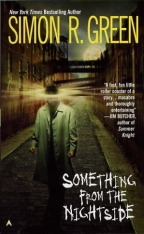
The Nightside novels


Warning: there be spoilers In The Nightside.


The premise is simple: a bizarre place called the Nightside coexists with London-as-we-know-it, and John Taylor is a detective who works and hunts In The Nightside, while trying to learn more about his own mysterious past.

What works

Most urban fantasies are set in some place that’s dark and gritty, and the Nightside is no exception. I was intrigued from the moment I read that In The Nightside, it’s always three o’clock in the morning, and the dawn never comes. It’s a flashy place, though, reminiscent of the Flesh Fair in Spielberg’s A. I. and crammed to the eyeballs with all manner of creatures and magic.

Most of the time, this is fascinating. I love good worldbuilding, so I enjoyed the Brittle Sisters of the Hive, the entity Lamentation and Pretty Poison. There are some vivid pictures and ideas here, to the point where I find them sparking my own imagination. And despite the plentiful references to blood, gore, death and pain, I didn’t find these books as dark as Perdido Street Station or Scar Night. Perhaps it’s the touches of humor here and there, or the fact that the main character hasn’t undergone any major loss or heartbreak so far.


What doesn’t work

I like variation and scope in worldbuilding, but sometimes it seems as though the author has never come across a speculative fiction concept that isn’t worthy of a mention – to the point that when I read about the protagonist eating celery to stave off poison gas, I knew there would be a Doctor Who reference coming up. It’s amusing, but it also reminds you that you’re reading a book, as opposed to being part of it, being there, In The Nightside. And I’m capitalizing those three words because the phrase is used a bit too often, both in the first-person narrative and in the dialogue.

There’s also no indication of how elves and Romans and demon succubi and Lady Luck and giant teddy bears and talking horses and poltergeists all fit together In The Nightside. The ecology, politics and economy of the place take a distinctly second (or third, or fifth) place to the next bizarre concept or person that the protagonist will encounter. But the books are so short that this is understandable; there isn’t a lot of room for characterization or complex plot.

Instead, it’s a fast ride through the Nightside. Pacing-wise, the books are fine except for the paragraphs of exposition - through both narrative and dialogue – though I was intrigued enough by the worldbuilding to read through these. At least they were never boring.
I haven’t said much about John Taylor because I couldn’t really connect with him. He’s also so overpowered that I couldn’t really be afraid for him either. He has a third eye, a private eye (yes, that joke crops up in every book) which enables him to find anything, and he can also affect things without touching them.

So, for instance, he can enter access codes to security locks, lift bullets out of people’s guns, sever the threads binding thralls to a demon, and so on. Sometimes this is described as “It was the easiest thing in the world…” but that doesn’t really make for lots of tension. When the going does get too tough even for him, he has friends, protectors or people he’s hired to watch his back. And at one point he even bluffs a magic door into telling him the password, simply by telling it, “What did I just say to you? What’s the password?” I love protagonists who outwit the opposition, but there just wasn’t much wit to out here.

The books are still entertaining. They’re so slim and fast-paced that I found them easy to get into and picked up a whole batch from the library, going through them like mini appetizers. They’re not the main course. But they’re a roller-coaster ride through a many-faceted place, and I could do worse than spend a little time In The Nightside.

Wednesday, October 1, 2008

How many books should you write?


My personal limit is: as many as I can.

The more books we write, the more we’ll improve as writers and the more horses we’ll have in the race. Agatha Christie wrote 86 novels. Isaac Asimov wrote or edited over 500 books. I’ve got a while to go before I hit those kinds of numbers, but I’m writing as fast as I can (the Page-a-Day Club at Absolute Write helps in that regard). Future projects include:

• Sub-urban fantasy: part of a modern city transported to a hellish fantasy world
• Pizarro’s revenge: the conquistadores are human, the natives most definitely aren’t, and there’s gunpowder. I love it when things get blowed up real good
• Epic fantasy: I want to try this with Redemption. I’ve recently read started Stephen Erickson’s Deadhouse Gates, and it’s quite inspiring in this regard

There are one-book wonders, of course. Margaret Mitchell and Harper Lee come to mind, but writers like this are the exception to the rule. There are too many writers who finish one book, try to get it published, fail and stop writing. Or (which seems equally common these days) get it published by some amateur micropress or vanity publisher and then spend years trying to get it shelved and sold, rather than continuing to work at the craft.

Writers need to write, and keep writing, no matter what else they do and no matter what happens to the first book. You can never run out of stories; the more you tell, the more come to mind, and if you’re tired of one series or genre, well, who’s to say you can’t try another? One of the perks of not being famous, after all!

So let’s keep writing.