Showing posts with label movies. Show all posts

Monday, February 16, 2015

Ender's Game, the film


When I heard Ender's Game was being made into a film, I was skeptical. The book is very character-driven, with so much happening inside Ender’s head, that I doubted a movie would work. So I waited until I could borrow the DVD from the library.

While the book will always be my favorite science fiction novel, Orson Scott Card went from being a writer whose skill I respected to a paranoid homophobe. But that’s not the reason I felt this movie wasted my time.

Everything that the book did well, the movie fails at. The book isolates Ender; he doesn’t get along with Bean at first, he’s separated from his friend Alai, and he has to defeat Petra’s army. It’s made very clear that as a commander, he cannot be chummy with subordinates. Which is why the scene at the end where he hears them speak to him, and realizes he’s going into battle with them, is so moving.

Here, they’re his pals from the start. The part where a boy sprains an ankle just before battle is so contrived, as is the magical substitution of Petra to fill in the gap in Ender’s circle of friends. Graff would never have done that to either Ender or Salamander Army.

Speaking of Salamander, in the book, Bonzo is a serious threat. In the film, he’s a foot shorter than Ender. What were they thinking? Bonzo is more muscular, but that height difference works against him. It was like watching a terrier confront a Great Dane. And it’s not as though Bonzo is written as a midget in the book. He’s a secondary character who could have been played by someone bigger than Asa Butterfield.

But the film really fell flat in the depiction of the battles. Those are my favorite part of the book. Ender’s Dragon Army starts out with a routine fight, but things quickly escalate from there. At first he has a battle every day. Then Salamander Army is let into the Battle Room before them and there’s nowhere to hide. And so it builds up to the final battle of the exhausted Dragons against two armies, when you know Ender is going to lose—and, as he tells Bean, he can’t afford to lose even a single fight.

The film shows one battle. One.

If time was limited, why not make this two movies? The problem with smooshing all of those battles into one is that there’s no sense of progression and improvement. The book presented clear problems and showed how Ender outthought them. Here, it’s as though Ender makes intuitive leaps of genius in a few days at most.

By having multiple battles, there was also a sense that Ender wasn’t the only brilliant or mature kid in the school: he learned from Carn Carby, he depended on Bean to come up with ideas, and so on. Whereas in the film, there are only two commanders, Ender and Bonzo. Who is not just a midget but easily dealt with—he’s scalded by boiling water which doesn’t seem to bother Ender at all.

Then again, Peter fares just as badly. In the book, it’s clear that although he’s something of a sociopath, he’s also intelligent, ambitious and manipulative. Here, he’s just a homicidal thug. I couldn’t imagine anyone in their right mind even considering him for Battle School. I didn’t expect the Locke/Demosthenes subplot, but why even have him in the movie if all he does is try to kill Ender?

I could go on and on—how ridiculous it is for a hive queen to skulk around ten minutes’ walk from the bunker, how Asa Butterfield is about as expressive as Kristen Stewart—but in the end, the greatest travesty is that the emotional power of the book is nowhere in evidence. I felt nothing while I watched this. I didn’t even want to listen to the director’s commentary, because one look at a sterile, jumpsuited future filled with lasers and explosions was enough for me.

So to summarize, there’s CGI and action sequences where things get blowed up real good, like Michael Bay minus crassness and hot chicks. If you need more, look elsewhere.


Friday, January 30, 2015

Othello


Othello is a well-made, well-acted and incredibly frustrating film.

I didn’t realize I’d have such a strong reaction to it. I’d read the play, so I knew how the story went, but watching events unfold was much more visceral an experience. And quite frankly, not one I want to repeat.

To start with the good: the acting is great. Lawrence Fishburne has immense presence as Othello, and I like the passion and spirit of Irene Jacob’s Desdemona. Kenneth Branagh stole the show, but then again, that’s what Iago usually does. I especially like the motif of the chess pieces, and how his tipping them into the well foreshadows what happens at the end of the film. Beautiful sets, costumes, music, the works.

No, what made me not want to watch the film again was the story.

It was easy to see the roots of Othello’s jealousy. Set apart by virtue of his race, he holds on to his position among the upper-class Venetians because of his value as a general. But once he goes to Cyprus, the Turkish fleet has already been destroyed. That’s a joyous event, but it also means there’s nothing more for Othello to do there, no way to keep proving his worth. As far as insecurity goes, that’s enough of a breeding ground for Iago.

I kept wondering, though: what does Iago really want? If it’s to be Othello’s lieutenant, Iago gets that after he plies Cassio with drink and instigates a brawl. He could stop there, but instead he goes on to poison Othello’s mind against Desdemona. “I hate the Moor”, he says at one point, but later, he engages in a blood-brother ritual with Othello and tearfully embraces him.

The power of Branagh’s acting is to make these disparate elements seem different facets of the same complex character, rather than inconsistencies. I’m not sure what Iago hoped to end up with eventually—everyone dead except for himself? Maybe. But I didn’t need to know that to be fascinated by his personality, not to mention his ability to keep half a dozen puppets dancing at the same time.

The frustrating part of the film isn’t just to see how Othello swallows everything hook, line and sinker, because a lot of people would succumb to expert manipulation. It’s everything that happens after that. He could question Desdemona openly and try to trust her. Failing that, he could leave her.

Failing even that, he could, if he felt justified in murdering her, do so quickly and painlessly.

Instead he puts her through hell. He insults her, humiliates her, hits her and finally forces her to endure a terrifying ordeal and a long-drawn-out death. It was nothing short of domestic abuse. And no matter how many glycerine tears Othello himself cries in the process, I couldn’t help feeling this wasn’t so much a good, decent man giving in to his fatal flaw as a wolf who was finally getting to take his sheep suit off.

So to sum it up: a very well-done film that, because of the subject matter, I found too depressing to watch again.


Tuesday, September 2, 2014

The Ghost and the Darkness


When I’m working on certain stories, I like background sound to match. The most recent WIP was set in an Africa-esque land, so I borrowed The Ghost and The Darkness from the library. Maybe I should have gotten Zulu instead.

The story behind the film is fascinating. In 1898, construction workers on the Kenya-Uganda railway were repeatedly attacked by two man-eating lions, who were finally shot by the project supervisor, Colonel Patterson. Patterson claimed the lions had killed over 130 of the workers. Whether that’s true or not, what I found most chilling was that the lions ignored, got through or escaped nearly all of the traps and defenses set up for them. So I settled in to watch.

I’ll start with the pros. Robert Beaumont, the financier behind the railway, is delightfully nasty, though perhaps I enjoyed him more because Val Kilmer’s Colonel Patterson is a such a bland good guy. Some of the minor characters like Abdullah are fun too. The lions in the film were real and the scenery is beautiful.

What prevents this from being Jaws-in-the-savanna is that Patterson is no Quint or Brody. True, anyone would be taken aback by a lion which doesn’t just attack at night, but stalks into the camp by day—and as Patterson aims his gun, he hears a growl from above him, the first indication of the second lion. That’s all good.

But the film then leaps ahead to thirty men having been killed, which made me wonder what on earth Patterson was doing for all that time. It might have been better not to stick close to reality here. Patterson finally builds a trap where the entering lion will set off a tripwire which seals it into a double-compartmented cage. The second compartment contains three armed men who will shoot the lion through the bars.

They all go to sleep. When the lion trips the trap, none of them put the barrels of their rifles between the bars. Instead they just fire, bullets ricocheting every which way until one such shot actually frees the (completely unhurt) lion, which runs off while the Three Stooges knock over a lantern and nearly burn themselves alive. Something similar happened in real life, but honestly, being faithful to the incident didn’t do the film any favors. I just wondered why in the world Patterson didn’t get into the cage himself. Or throw the lion poisoned meat. Or turn some dogs loose on it—didn’t they have Rhodesian Ridgebacks at the time?

Or hell, just wait for it to die of old age. Anything would have been better than what they did.

Then Remington shows up. He’s a big-game hunter who has something like twenty armed and painted Maasai on his side, and those are experienced lion hunters. I eagerly watched the Maasai ceremony, complete with the drinking of a cow’s blood, to prepare everyone for the lion hunt the next day.

Patterson, the idiot, swaps guns with someone else, doesn’t test out the new weapon he’s unfamiliar with, gets a misfire when he tries to shoot a lion who looms up before him, and does not get et for the sole reason that he is Val Kilmer, star of the film. Then the Maasai go home. I’m not kidding; the twenty armed and painted warriors, who have done nothing other than show up and do a ritual dance, decide the lions are evil spirits, and that’s the last we see of them.

To cap it all, there’s then a scene where Kilmer’s—I mean Patterson’s wife and baby come to visit him. As he’s running towards them, the lion appears, and the wife doesn’t seem to see or hear the Africans fleeing, the lion leaping or her husband screaming. Yep, it’s a dream. Like anyone really thought they would kill off the hero’s wife and child.

The Ghost and The Darkness was atmospheric and I liked the soundtrack, but other than the farcial aspects of the plot, there isn’t much else to recommend this.


Thursday, July 3, 2014

1408


Movies based on Stephen King’s novels or short stories tend to be hit or miss for me. I didn’t think 1408 was a waste of time, but it did drag in places, and unlike Misery, it wasn’t the kind of film that’s likely to stay in my memory for a long time afterwards.

The premise is simple: an author called Mike Enslin goes around staying in various haunted-house locations to expose them as shams. No such things as ghosts. It’s later revealed he’s an atheist whose only child has died. Just once, I’d like to see or read about a happy, well-adjusted atheist. I live in hope, unlike our hero.

Anyway, Mike gets an anonymous postcard from the Dolphin Hotel, warning him not to stay in 1408. Naturally, he high-tails it there, but the manager warns him not to go in. Mike holds his hand out for the key, opens the door and says, “This is it? It’s just a room.”

One thing I liked right away was that there were no attempts to “dress up” the paranormal element. No ancient Indian burial ground or satanic cult is responsible for what happens: 1408 is simply an evil room which causes people to commit suicide, and no one has lasted more than an hour.

At first, it all seems mundane. But then things start happening: the clock-radio starts up on its own, then resets the time to 60:00 and begins the countdown. When Mike tries to open the door, the key breaks off in the lock.

The film has a ton of moments intended to make viewers jump, and I jumped. But those aren’t what I feel is real horror. Real horror is something that keeps me awake at night thinking about it. There’s a chill factor, as opposed to a scare factor, and the film only had two of those really disturbing moments. They were great, but they couldn’t make up for the rest.

The first such scene is when Mike, trying to summon help from the window, sees a man in the building opposite. This man’s window is directly across, and when Mike waves his arms frantically, the man sees him and comes to the window. He waves back. Mike mimics “call the police”, and the man copies his actions. Mike’s desperation gives way to bewilderment as the man reflects his every move.

That really was creepy.

But then it gets better. A figure steps up behind the man and hits him with a hammer. Mike spins around, only to find the same figure attacking him. It’s an illusion, but an effective one.

Then Mike climbs out the window and inches his way along the ledge to the window of the next room. I was convinced he’d reach the open window and find himself right back in 1408. Still, it was suspenseful watching him move along the ledge, limbs spread for balance, counting off the steps. Then he looks sideways to see how much further he has to go—and there are no other windows. None at all. The camera pulls back to show a sheer brick wall.

I loved those two tricks. Unfortunately, everything else the room did was kind of—not predictable, exactly, but without significance. It didn’t matter if the room was splitting open or crashing in, because I knew it wasn’t going to destroy itself. And the room also makes it clear that Mike has to kill himself.

“…all guests of this hotel enjoy free will, Mr. Enslin. You can choose to relive this hour over and over, or you can take advantage of our express checkout system.”

On cue, a noose drops from the ceiling. Yet what the room really inflicts on him is terror and despair. That’s bad, granted, but no body parts are being cut off, nor is anyone else in jeopardy. Besides, if you know that everything you see is being caused by an evil room, then you’re not likely to wonder if you’re losing your mind.

In the end, Mike destroys the room with a bottle of brandy he turns into a Molotov cocktail. The room is perhaps aware that the film had to end, so it burns up. There’s a final attempt to wring a little more scare from the story by having Mike hear his daughter’s voice on his tape recorder, but it just didn’t work. As far as hotels go, the Overlook from The Shining is far more disturbing.


Tuesday, April 15, 2014

The Lovely Bones


If you’re not a fan of the book, there are only two reasons to watch The Lovely Bones. One, Saoirse Ronan’s acting. Two, the CGI. Everything else is… well, I’ll get to that.

The story is straightforward. Fourteen-year-old Susie Salmon is lured into a hideaway by a neighbor and killed there, but her spirit, from heaven, watches as her father and sister try to find out the truth and slowly put their lives back together. The theme is one of accepting what we can’t change, relinquishing what we can’t have and learning to let go. But in a happy way, because there’s something good ahead.

Saoirse Ronan is a talented actress, and it’s difficult not to like her as a teenager who’s by turns exuberant, shy, annoyed with her parents and filled with dreams—typical, in other words. And the scene where Mr. Harvey meets her in the cornfield and persuades her to check out a cool underground room is very tense.

Stanley Tucci’s performance as George Harvey is… mostly good. A bespectacled middle-aged man, he’s the embodiment of the phrase “banality of evil”. What I found a bit difficult to buy was the way he babbles and giggles once he’s lured Susie down. I get that he’s excited (while Susie quickly realizes something’s wrong) but he’s more scary when he’s calm and serious.

What I also found difficult to buy was that he excavated this room in a field in winter and no one noticed. There’s a shot of him digging at night, but it’s still an elaborate feat of secret construction. Still, the best way to enjoy this film is not to think deeply. For instance, if I went to my personal heaven (a limbo meant for people who haven’t yet moved on), I would want to be with people I cared about. Instead, Susie gets Holly, a girl who appears out of nowhere and who tells Susie nothing about herself, but who becomes Susie’s BFF.

If you’ve ever watched Mary Poppins, remember the scene where they go into the chalk painting? Something similar happens here. With her new pal, Susie romps through a magical landscape that keeps changing to entertain her. No lingering trauma from murder, no attempts to change anything or tell her family the truth.

And it’s clear that she can influence the occasional event on Earth, if she tries hard, but her major accomplishment there is to put herself in a living girl's body so she can finally kiss the boy she likes. Meanwhile, just outside, Mr. Harvey disposes of the safe containing Susie’s body, which she knows about. Yet the kiss is more important.

I suppose that was part of her acceptance-and-letting-go, to not care about her body… but wouldn’t her parents care? Wouldn’t they want her remains to be laid to rest with dignity, rather than never even knowing where she might lie?

But, like I said, don’t think too much. Or you might wonder, if the real heaven is a place where there’s “no memory”, is there a blank in your mind when you try to think of how you got there? And it’s clear that Susie’s heaven is influenced by other victims of Mr. Harvey’s, which leads to a truly schmaltzy scene where all of them come smiling out of the horizon while the music swells.

I did get teary when the little girl—the youngest victim, who’s six—gives Susie an evaluating look, then smiles, runs up to her and hugs her around the waist. But then I wondered, is that girl going to stay six years old for ever? An eternal child, frozen at the moment she died? Anne Rice did that more realistically with Claudia in Interview with the Vampire.

I understand why the joyous get-together, since there was a previous scene when Susie’s heaven showed her the corpses Harvey had discarded, so Jackson had to assure the audience that these women and girls are now frolicking in paradise. Plus, they’re all friends together in a Raped-N-Murdered club.

But back on earth, Susie’s father is ham-handed in his attempts to find her killer and to stop Harvey, whom he suspects despite having no evidence. So her sister breaks into Harvey’s house to find some. This is the second tension-filled scene in the film, though I have no idea why the sister carefully leafs through Harvey’s scrapbook upstairs even after she hears him enter the house. Wouldn’t it be better to leave and then check out the book?

Still, all ends well. This isn't a bad film per se, just a slow-moving one which has little going for it besides its prettiness and philosophizing. I couldn’t help sympathizing with one reviewer who said Susie’s endless voiceovers became so annoying that if she wasn’t already dead, he would have shot her.

Thursday, March 27, 2014

Snow White and the Huntsman


I saw Snow White & The Huntsman for the first time a few days ago, maybe because I had a craving for Game of Thrones. Unfortunately, this was like wanting a slice of warm apple pie topped with a scoop of ice cream, and getting an apple core to nibble on.

I’ll start with the good. The black glass warriors were very cool. Also, I liked the music at the end (the coronation plus the song that plays over the credits).

Other than that, everything was blah. Except for Charlize Theron’s turn as the evil queen Ravenna, who reminded me a little of Jeremy Irons’s evil mage Profion in the similarly awful Dungeons & Dragons. It’s as though they realized they were the only elements in the films with the potential to be something other than dull, but regardless, they couldn’t possibly make the films worth watching. So they just went to town on the scenery-chewing.

I can’t even think of Kristen Stewart’s character as Snow White. That character is Kristen Stewart, wearing a perpetually dazed and open-mouthed expression. The sets and clothes are so grungy that her two upper incisors, always on display, look all the whiter in comparison. Even when she’s crowned queen, she just stands there silently with her chest heaving, a tabula rasa to the end.

You can tell they were going for a Joan d’Arc vibe, because to gain her throne she put on armor, led a tiny army and fought the evil queen, but all throughout it I just wondered why no one was wearing a helm. Plus, the resolution of the battle is telegraphed from the moment she meets the titular huntsman. If a man teaches a woman a self-defence move, I guarantee the woman will pull that move out at the last minute to save herself from the villain.

Another problem is that I was never sure what was the source of the evil queen’s power. Shades of Elizabeth Bathory here, since she imprisoned a girl, fed on the girl’s youth and became beautiful while the girl grew old. But apparently there’s a whole village of women who have deliberately scarred their faces (just pale lines down their cheeks, wouldn’t want to gross anyone out) to deter the queen from choosing them. So… she derives her youthfulness from only hot women?

Then she eats a bird’s heart, and of course she wants Stewart’s as well – though why she kept Stewart locked up in the tower for years is anyone’s guess. As for the nature of her power, that goes beyond youthfulness. She’s got Wolverine’s healing factor, Mystique’s ability to change her appearance, super strength and telekinesis (she can raise a portcullis by walking to it). Oh, she also changes into a flock of birds. Basically, she’s all over the place, and no, I have no idea why Stewart was able to kill her at the end. But it was a relief, because that meant the film was over.

The dwarves were awful, the takeover of the castle was unbelievable, and the black glass warriors were utterly wasted. If millions of shards of obsidian fly at you at high speed, you’ll need to be rinsed off the walls. Of course, Stewart’s love interests are barely scratched.

These love interests are the scruffy huntsman (who doesn’t even have a name) and some pretty-boy duke’s son, both of whom kiss her after she eats the apple. I’m sure you can tell which one’s kiss works, but this is a modern retelling, not “Some Day My Unshaven Prince Will Come”, so he just exchanges a few angsty glances with her afterwards.

The queen, a self-made widow, has a love interest too – her brother. Yes, they were going for Jaime/Cersei here, because this film is a patchwork of borrowed concepts covering up a whole lot of nothing. The brother has a silly haircut and that’s about all I can say of him.

If you want to see a strong yet vulnerable princess, watch Pan's Labyrinth instead, because Ivana Baquero can act, plus there’s a gripping story and a believable villain to go along with her. Everything this film doesn’t have.

Sunday, March 2, 2014

Grizzly Man


The story in a nutshell: Timothy Treadwell was obsessed with grizzly bears and spent over a decade of summers filming them in a national park, taking unbelievable risks and breaking regulations to do so. At the end of the thirteenth summer, in October 2003, he and his girlfriend were both killed and partially eaten by a bear. Grizzly Man is a documentary by the director Werner Herzog, featuring Treadwell’s footage of the bears plus interviews with people who knew him.

Before I was five minutes in, I knew Treadwell wasn’t mentally balanced. Filming himself with a bear feeding in the background, he claims he’s a “kind warrior” but adds that if the bears become aggressive, he needs to be a “samurai”. He seems to be just one katana short of a Quentin Tarantino movie.

Treadwell frequently claims he’s protecting the bears. Park Rangers make it clear that there is no poaching in that particular area—and I believe them, because if Treadwell had stumbled across corpses with their gall bladders cut out, that would be on tape. Instead, all we see is him wearing a faceful of camouflage paint as he stalks imaginary poachers. If I were hunting grizzly bears, with the kind of gun that could take those out, a skinny unarmed man with a camera would not be a problem.

The only other people he actually comes across are also there to take pictures, which inspires a rant from Treadwell about “commercial people” invading his turf—I mean, the bears’ turf—with cameras. The irony seems completely lost on him. These people, having spotted him despite his masterful camouflage, pile up rocks and draw a tiny smiley face on them. Treadwell films that carefully, then explains it’s a warning.

Yes, he’s paranoid too. Or just so delusional he imagines he’s in a movie where he’s the hero, the animals are his loyal sidekicks and everyone else, from the tourists to the Park Rangers, is the villain.

Putting aside his need to play bear whisperer—his only claim to both fame and financial support from his fans—the problem with his actions isn’t only that they culminated in the deaths of two people and two bears. It’s that, for all his claims to understand and love grizzlies, very little of what the documentary shows us is actually about them.

Treadwell is in the forefront of nearly every shot. When he comments on the bears, it’s not to point out some aspect of their lives which might otherwise have gone unnoticed—it’s to say this is a friendly bear whom he’s named Mr. Chocolate. At times he comes off like a child - “He’s a big bear! A big bear! Wow!”

For me, the fascination of wild animals is their wildness and their animal nature—what makes them different from us. As a helicopter pilot said, Treadwell acted as if the grizzlies were “people in bear costumes”. He croons “I love you” to bears and foxes in a high-pitched voice, as if sending out enough happy thoughts will make them “bond as children of the universe”, as the pilot put it.

The film is like watching someone play Russian roulette again and again, giggling with the thrill. At one point, a bear is swimming and Treadwell enters the lake up to his waist. The bear paddles out. As it moves past him, paying him no attention, he taps it on the rump.

This is more than being an adrenaline junkie. This is someone who can’t stand being ignored. Imagine a stranger in your house, someone who didn’t speak any language you could understand but who followed you around making occasional attempts to touch you. That’s wildlife harassment, something the National Park Service noted in their file on Treadwell.

Rather than watching the animals as they go about their lives, Treadwell forces himself into their environment. A few shots of bears where he isn’t looming in the foreground show his fingers darting into the frame to touch the bears’ muzzles. He sets up his tent in heavy brush, between two dens of foxes, and pets their cubs—all of which has the effect of habituating them to humans.

Amie Huguenard, his girlfriend, is a silent nonentity. She appears in only a few minutes of his footage, keeping her head down because a nearby bear is looking in her direction. It’s obvious she’s afraid. A professional in her mid-thirties, she felt he was “hellbent on destruction”, as he wrote in his journal, and was planning to leave him.

The only parts of the documentary I could enjoy were those which focused on the beautiful scenery, and where Treadwell was too far away from the animals to either bother them or be in the picture. Like this one.


The film is worth watching if you want a glimpse into a seriously disturbed mind and are prepared for many jawdrop moments. I won’t even get into Treadwell’s rant about how good he is to “girls”, who don’t seem to appreciate his many wonderful qualities. Ultimately this quote from the director sums it up for me.

And what haunts me is that in all the faces of all the bears that Treadwell ever filmed, I discover no kinship, no understanding, no mercy. I see only the overwhelming indifference of nature.

Which is as it should be. The bears owe us nothing. Superimposing human relationships, thoughts and emotions on them isn’t just meaningless, it’s dangerous to us and disrespectful to them. It diminishes them, makes them Furface or Cuddles instead of the magnificent wild animals that they are. That’s something Timothy Treadwell would never have agreed with. Because without the animals playing supporting roles, providing an exciting background—and purpose—to the movie of his life, he would be alone on an empty stage, a nobody.

Sunday, December 15, 2013

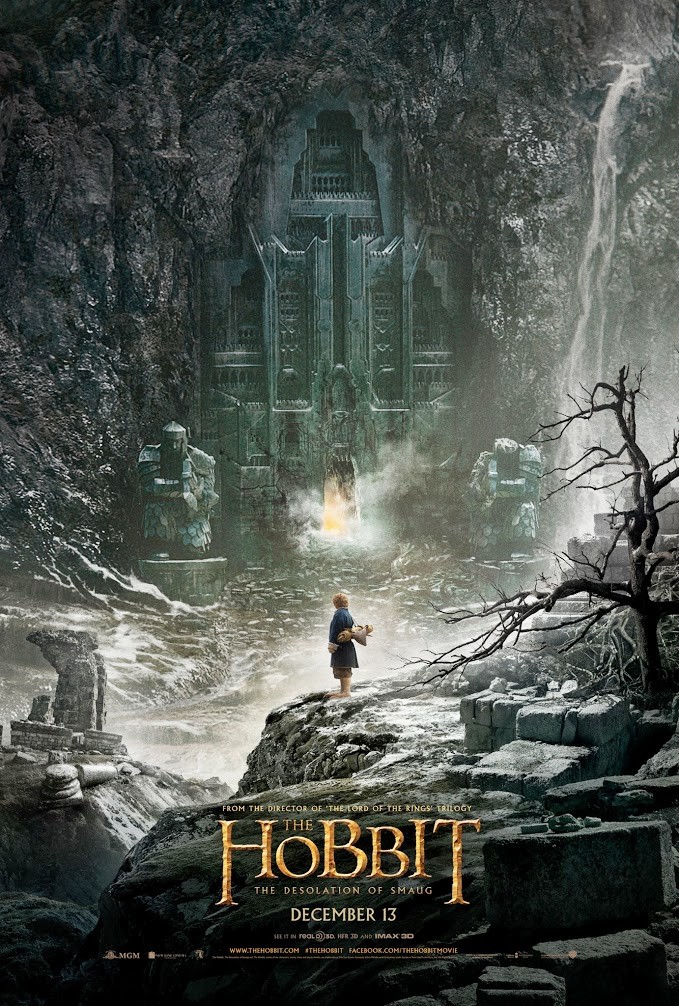
The Desolation of Smaug


My Christmas present to a friend was tickets to The Hobbit: The Desolation of Smaug. My friend’s gift to me was a handmade, solid wood bookcase, but that didn’t turn out as we’d hoped either. I’ll blog about that one soon.

For now, we’ve got movie review sign.

I’ll start with the good. Visually, this is a very vivid film. I loved the locations and all the little details like the huge honeybees in Beorn’s stables.

That was about it, unfortunately. So what didn’t work?

In the book, Gandalf cleverly entertains Beorn with the story of their journey, so he’s more interested in that than in the steadily growing number of dwarves in his house. The film begins with a giant bear chasing them all into the house, but he changes into a man overnight and serves them breakfast in the morning.

That sets the tone. Over-the-top action with cartoon physics is going to be the norm, and characterization falls by the wayside. Beorn, for instance, doesn’t show his caring for his animals by requiring the dwarves to return the ponies, nor does he follow them to make sure they’ll do it, nor do the dwarves grumble at the prospect of trekking through Mirkwood afoot.

Then again, they step into Mirkwood, wander around in a daze like they smoked some very “special” pipeweed and get caught by the spiders. It all happens in one day, perhaps in a matter of hours. I was looking forward to the food running out (imagine the genuine humor that could have resulted), not to mention Bombur falling in the river and having to be carried. None of that. None of the songs, either. But wait, there’s Legolas!

Legolas was never my favorite character in The Lord of the Rings, but there he was at least a canonical part of the Fellowship. Here, he’s shoehorned in to be eye candy for the distaff side of the audience. For the men, there’s Tauriel.

One of my pet peeves in movies is when the producer decides an all-male cast is bad, so he adds a woman who’s gorgeous and kicks ass and falls for the hottest of the males. Basically, she’s a Token Female Action Girl. I’d rather just see an all-male cast, and Tauriel has no personality other than feisty, flawless and fond of Kili, with whom she flirts in an awkward, cliched way.

Kili, for his part, tells her a sob story about how he promised his mom he’d come home. Goodbye, Kili. You were nice in the first movie. I hope you escape soon, and I don’t mean from the elf jail.

Bilbo breaks them all out, but instead of closing the barrels, they all sail along in open upright barrels with Bilbo clinging to the side of one of these. Which would be fine, except Bilbo calls himself “Barrel-rider” when he’s talking to Smaug. When exactly was he riding?

The Orcs chase them. Legolas and Tauriel chase the Orcs. Much action ensues. Legolas actually gets slammed around by the Orc leader on one occasion, but of course he still looks like Barbie’s perfectly groomed younger brother, except for a single artistically placed trickle of blood. Meanwhile the dwarves reach Laketown and meet Bard, your Generic Hero with Adorable Children Who Adore Him.

Then they reach the Lonely Mountain. Bilbo is the only one clever and persistent enough to get them in, and his reward is to be sent to find the Arkenstone (there’s some backstory about how that will unite the dwarven clans somehow). He tiptoes in and Smaug wakes up.

Smaug is the single biggest disappointment in a film crammed to the ceiling with disappointments. He can’t kill one hobbit who’s visible — yes, unlike in the book, Bilbo takes off the Ring and talks to him. He senses the presence of the Ring, yet doesn’t seem at all interested in acquiring it. Then he tries to kill the dwarves and fails miserably.

In fact, the dwarves outwit him at every step of the way, even using his flames to fire up their forges, which make a giant golden statue of a dwarf. It looks like one of those big gold-foil-wrapped chocolate Santas. Smaug stares at it like he’s wondering if it’s a pinata, and the statue dissolves, drowning him in molten gold.

Sadly for Thorin, he hasn’t read A Game of Thrones, so he doesn’t realize that molten gold cannot harm a real dragon. So Smaug swims out and says he’s going to Laketown. Bilbo runs up shouting that those people are innocent. Smaug growls something about revenge, turns and flies off. Presumably he realized the script wouldn’t permit him to so much as singe the beard of a single dwarf in this film — let alone a visible hobbit standing a few yards away and shouting at him — so his only options were either to go to Laketown or to sit around in the Lonely Mountain until a handful of dwarves ate him.

And there the film ended. Thanks be to Eru.

Oh, Gandalf. I almost forgot about him, which is pretty easy to do. He had a major role in the first film, but here he just seems to be at a loose end until the Necromancer captures and imprisons him, like Saruman did in The Fellowship of the Ring. Radagast and his bunny-sled show up for a cameo, but he doesn't do anything either.

This film shows the results of trying to stretch a children’s book out to cover three movies. It’s mostly action, action, action, with none of the camaraderie of the first movie. The dwarves don’t tease Bilbo or joke with each other, and there’s no point in Smaug roaring, “My wings are a hurricane and my breath death!” if he can’t actually do anything except let the dwarves make a fool out of him. Finally, one question. How does Thranduil have both long flowing white hair and eyebrows like Ugly Betty’s?

Tuesday, September 24, 2013

Open Water


Open Water is an amazing film.

It's not perfect. It's an indie movie shot on digital video, and the movie was made over a span of three years because the crew could only film on weekends away from their day jobs. It's also not a typical disaster movie or killer-animal film, and if you're looking for a happy ending, you won't find one. But in terms of steadily growing mental horror, it's brilliant. I'm actually relieved I didn't watch this on the big screen; I'd have had nightmares.

Susan and Daniel are two stressed but well-to-do people who decide they need a vacation. Leaving their SUV and cell phones (though they bring their laptop), they go on vacation. Sun, sand, surf and scuba-diving. Part of the latter is a trip out into the ocean with eighteen other tourists, where they all go on a group dive.

One of the crewmen of the boat hosting the dive keeps track of the passengers by making a tick on a clipboard as each passenger climbs out of the ocean. However, one guy has forgotten his mask so he doesn't dive, but he sits with the returning passengers anyway and the crewman makes a tick corresponding to him. Then the guy borrows a mask and goes for a dive, so when he returns to the boat he's counted for a second time. Since he's taken another returned passenger with him as a diving buddy, that guy gets counted twice too.

The upshot of it all is that Daniel and Susan, who have separated from the main group, are deep below the surface when the crewman counts twenty ticks and says, "Got everybody!"

No, I have no idea why they couldn't simply do a head count - there are twenty passengers, not two hundred. Or better still, get the list of names (you know the names of people traveling on your boat, right?) and call them out or have people sign off beside their names. If I hadn't known that this was based on a true story of two people who did get left behind by a boat, I would have found it very difficult to suspend disbelief at this point.

The filmmaking at this point is good, though. When Daniel and Susan are taking photographs of all the colorful fish, the music is cheerful and light-hearted. As divers return one by one and you realize something's wrong, the music stops. As the crew is pulling up the ladder and preparing to leave, the music is very low-key in the background but ominous nevertheless, and suddenly all the fish have disappeared. Daniel and Susan look around, realizing they're alone in this vast blue world, and they communicate with hand signals that it's time to surface. They're still early, since the crew said they would leave at 10:30 and it's 10:25.

They surface and there's no boat nearby. There are two boats on the horizon, both well out of swimming distance and both too far to catch a glimpse of the two people frantically waving to them.

Daniel and Susan try to stay calm. This is just part of their adventure, and soon enough their boat will come back for them.

"What if they don't know we're missing?"
"There's no way... Our stuff is on board. We have their tanks!"


Unfortunately for them, the world's most incompetent tour guides don't do a head count as the passengers disembark, don't check the boat to make sure everyone's personal belongings are off it and don't even count their own tanks to make sure these have all been returned. If this is normal operating procedure, the surprising thing isn't that two divers were left behind; it's that this hasn't happened more often.

Though they quickly realize that they're drifting away from the dive site, carried on the current, Daniel and Susan try to stay calm and play a six-degrees-of-separation game. That comes to an end when jellyfish sting them and a fin flashes above the waves for a second.

One of the things I like most about this film is that the sharks are just animals in their natural environment, doing what animals naturally do, rather than swimming around with a KILL ALL HUMANS mentality. The film never focuses on them for too long, so we see them in quick glimpses just as Susan and Daniel might.

On the surface, there's nothing but waves. Below the surface, something is coming closer - and that something is far more at home in the sea than you are.

The film plays brilliantly on this. "I don't know what's worse, seeing them or not seeing them," Susan says at one point, and although I love sharks, some of those sequences scared the hell out of me. The grey reef sharks in the film are perhaps five or six feet long, but they gather in groups. At one point Susan falls asleep after waiting several hours for rescue, so she's floating on her aqualungs with just her head and chest out of the water. Daniel dozes off too and they drift apart. The scene shifts to an overhead view and we see Susan in the water, her eyes closed, as the shapes of sharks move just beneath her.

And these were real sharks. No CGI, no mechanical models. The real things, swimming a few feet under her.

Another thing the film does very well is to show just how helpless we are once the trappings of civilization are gone. With literally nothing between them and the ocean except for their wetsuits, Daniel and Susan are, effectively, doomed. They can't control where they're going or see what's beneath them. They can't anchor themselves to anything solid or even scratch a mark to show that they were once there and alive.

This is in stark contrast to a scene from the start of the film where they're in their hotel room, and Susan is bundled up protectively in a sheet while Daniel stalks a mosquito. He finally corners it and whaps it. These two are possibly the last people in the world who should be lost at sea. Then again, it would take superhuman ability and luck to survive under those circumstances.

And they have no luck. No friendly dolphins push them to shore, no ships pass close enough to see them, not even a convenient piece of driftwood floats by. Something takes a small bite out of Susan's leg and fish begin to feed on the exposed flesh.

Mentally as well as physically, they give way under the strain. Daniel finally has a tirade where he screams, "We paid for this! We paid those incompetent fuckers to drop us in the middle of the goddamned ocean!" but the argument quickly spirals down into whose fault it is that they're lost. Daniel's, because he spent too much time looking at an eel. Susan's, because her job meant they had to settle for this vacation.

By the time a storm begins, though, they're both too worn out and too terrified to quarrel any further. Night falls and the sharks hunt at that time, as sharks are wont to do. Daniel, after being bitten, starts to pray but then breaks down in sobs. The ocean doesn't care about either. And if I thought it was frightening to be alone in the water, it's far worse to be alone in the water at night. The filmmakers don't illuminate anything except what's revealed by the occasional flash of lightning, and the terror is all the more visceral as a result.

Finally, the next morning someone discovers their belongings on the boat and a search begins. By then, though, it's too late.

Open Water isn't perfect. The start of the film is slow-moving, though there's a nude scene thrown in as if to reward the audience for persisting that far. There's also a sequence in the middle which focuses entirely on water rippling and flowing, and this goes on for a little too long. We get it. There is a lot of moving water in this film. But the rest of it is gripping. And if I ever decide to go scuba diving, I'm going to do so very close to land.

Friday, November 4, 2011

The Full Monty


It’s easy to imagine the high-concept for this film: “Six unemployed steelworkers become strippers”. But that short-changes The Full Monty, because it’s much more than a bawdy comedy. There are a lot of films I enjoy, but only one so far where I’ve shelled out for the DVD, and this is it.

The films begins after Sheffield’s steel industries have collapsed, and months of unemployment have left most of the former steelworkers depressed and cynical. Gaz can’t afford child support, despite his various schemes for earning a quid here and there, while his best friend Dave is physically as well as financially impotent. Dave’s wife, now the family’s breadwinner, feels he’s given up on her as well as on himself, so she goes out for the night to watch the Chippendales perform.

But that gives Gaz an idea. “Them buggers can, we can,” he says, and proceeds to round up a reluctant handful of his fellow unemployed.

Gaz is the linchpin of the film, a wonderfully drawn and acted character. In private he’s unsure of himself; with the rest of the gang, he’s driven, confident and energetic. He’s engaged in a constant juggling act as he tries to keep everyone more or less doing as he wants – all so he can continue to see his son.

The other characters are great too, though. Gerald, their ex-foreman, still hasn’t told his wife that he’s been unemployed for six months, so every day he dresses in a suit, takes his lunchbox and heads out to the Job Centre. Lomper is pale, skinny and suicidal – the scene where Dave fixes Lomper’s car’s engine and smoke immediately begins to fill the car’s interior is hilarious. Guy can’t sing or dance, but with his physical attribute, he may not need to. And Horse can dance, but needs a hip replacement. “Me breakdancing days are probably over, but there’s always the funky chicken,” he says.

As if six of the unsexiest wasn’t a recipe for success, Gaz is then put on the spot by a woman who asks why anyone would pay to see them instead of the Chippendales. “This lot go all the way,” he claims, giving the film its title and nearly scaring all the others into hanging up the G-strings for good.

But as they exercise and rehearse together, deal with their various problems – which eventually involve the police – and work up the nerve to take it all off, they slowly start to regain the friendship, confidence and masculinity they lost along with their jobs. For a comedy, this film touches on some surprisingly deep issues. It made me care, it made me laugh and it made me buy the DVD. Recommendations don’t get much better than that.


Saturday, June 4, 2011

She-Devil


I watched this 1989 film when it first came out, and then saw it again last weekend. It's still entertaining, maybe even more so - not only is it light and fast-paced, but now I enjoyed everything about Mary Fisher and her writing. She-Devil is a hilarious film.

Ruth Patchett is a plump, unattractive woman married to Bob, a handsome accountant whom she loves dearly. One evening, though, they both meet Mary Fisher at a party.

Mary Fisher is blond, slim, beautiful and a bestselling romance novelist. Everything about her life is built up around that persona; she lives in a castle-like house, dresses in pink and speaks in a breathy whisper. She’s like a Barbie doll come to life.

Sparks fly instantly, and Bob drives her home that night. Ruth tries to remain loyal and devoted during the affair that follows, but the situation in the Patchett household devolves. Finally Bob moves into Mary’s castle and tells Ruth that while he has four assets (his house, his family, his career and the freedom to do as he pleases), she’s a liability. And also a she-devil.

So Ruth behaves like one.

If you enjoyed the revenge plot of The First Wives Club, you’ll like this as well – and there are other parallels between the two films, including Ruth’s outreach efforts to other women, which pay off handsomely for her. I also loved her way of dealing with asset # 1, the house, but then again I’m a fan of creatively blowing things up.

And she locates an unexpected ally in Mary Fisher’s irascible mother, who’s never forgiven her daughter for sending her to a retirement home where she’s kept drugged and locked away. Mrs. Fisher is like a really nasty Sophia Petrillo.

Bob : You know, Mrs. Fisher, I haven’t told you what a wonderful daughter you’ve got. You did a terrific job of raising her.
Mrs. Fisher : You’d never know it, the way she treats me. Miss Famous Writer over there. You would think a forty-one-year-old woman would have learned to appreciate her mother.
Bob : Mary… I thought you were thirty-four.


The acting in this film – on everyone’s part – is delightfully over the top. Scenery is chewed with abandon. I especially liked the way Mary goes from soft-spoken and giggly to sharp-tongued and bitchy as her life slowly crumbles and she finds that being a man’s de facto wife is not quite the same as being his mistress. And the scene where her newest book flops thanks to all the stress was actually a little painful – especially when she sits at a table piled with copies and everyone ignores her.

Don’t expect realism from this film, but do expect a boisterous, amusing ride.


Tuesday, February 15, 2011

"Atlas Shrugged" trailer


I'm picky about the movies I watch, but I may go to see this one, though somehow I don't hold out much hope for it.

The novel wasn't bad per se, though I have never been able to get through the whole of John Galt's speech in one sitting. The trailer just looks... problematic, though.

According to Wikipedia's entry on the film, it's set in 2016. Five years from now and they still rely on trains to that extent?

That's not exactly my idea of a "timeless" setting. It's the nineteen-forties (trains, ladies in long white gloves) juxtaposed with modern times.

On the other hand, it's a dystopian version of the United States. That might explain why all the characters seem so whitebread except for Eddie Willers, the sole black person in the trailer. He was doomed from the start, poor guy.

This is also advertised as Atlas Shrugged, Part I. If John Galt's speech is included in its entirety, there will be at least three parts (and possibly a lot of popcorn hurled at the screen). That worked for The Lord of the Rings, but I'm not sure how intrigued audiences will be by Atlas Shrugged, especially since the trailer makes it look as though the film is all about running a railroad and dealing with government officials.

There's no hint of the mystery that kept me reading the novel. I didn't really care who John Galt was, but I was curious about why people kept disappearing. That was a lot more interesting than moratoriums on railroad bonds. The film will probably still do well, but I won't exactly be going into it with the delicious anticipation that I felt at the start of The Lord of the Rings.

I just hope it won't be a trainwreck (no pun intended) in progress.

Friday, December 31, 2010

Deep Blue Sea


Spoilers!

I’ve been afraid of sharks ever since I watched Jaws, but it took a less well known work of Peter Benchley’s – a short story called The Day The Sharks Died – to make me fascinated by them. Now I’m convinced that sharks get a far worse rap than they deserve.

And nowhere is this more obvious than in the film Deep Blue Sea, though to be fair, nearly everyone in it is a nonentity or a caricature. The sharks just get treated the same way as the rest of the characters, that’s all.

But to start at the beginning, the premise of this film is that a scientist, Dr. Susan McAlester, is extracting serum from mako sharks’ brains to cure Alzheimer’s. As scientists always do in bad horror movies, though, she can’t leave well enough alone and so she genetically engineers sharks with bigger brains that produce more serum.

All together now : “She tampered in God’s domain.”

Naturally, that makes the sharks superintelligent and the scientist considerably less so. Seriously, who would do this without building in some kind of failsafe mechanism, like the dinosaurs in Jurassic Park all being female and lysine-deficient?

I did like Aquatica, the research facility out in the midst of the ocean. Communications tower, undersea labs, a huge pool for the sharks, security cameras, crawlways and so on… this place could have been used to tell a much better story.

This one, though, is dead in the water. Take the sharks, another CGI creation that had the potential to be far more. In Jaws, one ordinary shark was enough. This film multiplies that by three and makes them superintelligent too. One shark causes a helicopter to crash, while another turns on an oven when the cook is hiding inside (one of the few good scenes). And while they don’t yet understand the concept of electricity, they’re real good at playing keepaway.

But even their murderous nature is a predictable trope. Why is it that any time an animal becomes intelligent, that flips a switch to either HELP HUMANS (if the animal is a dog or a dolphin) or KILL HUMANS (if the animal is anything else)? The sharks would have been so much more fascinating if they had had their own non-human-focused agenda – or if escape was more important to them than swimming into narrow little corridors looking for humans to eat.

Ah, the corridor scenes. Yes, it’s very suspenseful when you’re wading through waist-deep water in a long corridor, and you look back to see a fin rippling towards you.

Of course, then you wonder just how tiny this shark is, if it’s perfectly at home in water that’s three feet deep – not to mention filthy and full of floating or submerged debris. There was probably a reason that the Jaws attacks took place in the ocean, rather than in, say, a swimming pool.

Finally there’s the heroine. Other than the stereotype of the mad scientist, she has so little personality and affect that she seems in need of that magically fast-acting brain juice herself. And since she caused the whole mess, I expected her to be eaten by the sharks, but she survives until the end and then sacrifices herself in a completely needless gesture. If the last surviving shark will abandon its plans of escape and race back into danger the moment it smells her blood (so much for superintelligence), why does she need to cut herself and leap into the water? She could have held her cut hand over the edge and pushed a heavy piece of debris in.

But by then the audience was probably sick of her. The two surviving characters certainly were – a few minutes later, after the last shark audibly chomps her and dies, they lie back and chuckle in relief. I know how you feel, guys. The appearance of the closing credits was the best part of this film.