Friday, July 24, 2009

Plagiarism


July 17 was Anti-Plagiarism Day.

I’m a week late and a dollar short, and the blog post to which I’ve linked, from Jane Smith’s “How Publishing Really Works”, sums up so many notorious cases of plagiarism in this industry that there’s not much I can add. But it did make me remember a case of plagiarism that I once encountered, years ago.

This was back when I used to post on the Internet Infidels Discussion Board under the handle “Queen of Swords”. A relatively new poster started a thread saying that one of her professors had asked to meet with her to discuss an essay she had handed in, and she was worried that she would be accused of plagiarism. She was adamant that she hadn’t done it, and put the text of her essay up on the discussion board for us to read.

Someone Googled a sentence or three from it. An article (written by someone else) showed up on the first page of hits, and matched the rest of the essay perfectly too.

The backlash against the poster was pretty severe, especially since many of us had originally reacted with sympathy. Someone even emailed the dean of her college with a link to the discussion. I’m still not sure why the student asked us for support when she knew she was in the wrong – perhaps she was in denial – but she had an explanation for why her essay was identical to the article. She’d copied the article off the web to use in research, and then she had mistaken it for the rough draft of her own essay and handed it in by mistake.

Seriously.

Plagiarism these days is all the more difficult to get away with. But also easier. On the one hand, it’s incredibly easy to enter text into a search engine and see what comes up. On the other hand, outside of an academic setting, plagiarism is more difficult to detect and identify. Plagiarists could, for instance, copy from out-of-print novels or (relatively) obscure articles, such as the one on black-footed ferrets which was plagiarized for a bodice-ripper.

It’s not as kinky as it sounds, honest.

Back when I had no money to buy a plane ticket to get out of the Middle East, I wrote some college application essays for a young man with more cash than spelling. I’m not proud of it, but I didn’t feel there was any other choice under those circumstances. Ripping off someone else’s writing wouldn’t be something I could do even then, though. Who would ever trust that anything I produced after that was my own work?

Plagiarism is just a bad thing all around.

Tuesday, July 21, 2009

A Little Princess


"It's all very well to suppose things if you have everything," said Lavinia. "Could you suppose and pretend if you were a beggar and lived in a garret?"

One of my favorite books is Frances Hodgson Burnett’s riches-to-rags-to-riches story A Little Princess. It hooked me from the start, where seven-year-old Sara Crewe, meeting the greedy headmistress of her new boarding school for the first time, wonders why the woman is calling her beautiful. Sara is self-assured and intelligent, but doesn’t have any opinion whatsoever of her own looks.

And interestingly, this isn’t a chance for the author to show that Sara really is a beauty without knowing it. In fact, the story explicitly states that she looks like a Shetland pony when her dark hair falls around her face rather than being tied back, and her only really notable features are her eyes. That’s a great contrast to the titular character of Burnett’s Little Lord Fauntleroy, who’s as flawlessly perfect on the outside as he is in every other way.

I couldn’t stand him, but I liked Sara right away, especially after reading about her love of books, her imagination – vividly revealed in her telling of stories, her generosity and her courage in the face of adversity. Even after her father suddenly dies, leaving her a pauper and a servant in the boarding school, Sara struggles to remain a princess on the inside – kind to those who have less than she does, polite and proud and self-controlled, despite her hot temper and the harsh treatment she receives. She has no money and no hope of a future, but she has character, and that has been very appealing to a lot of readers.

So it’s no surprise that A Little Princess has been filmed – more than once, and there’s a televised version as well. I tried watching the 1939 film, but there were too many changes made to the original story (such as Captain Crewe being found alive), and Shirley Temple as Sara just did not work for me.

Then I watched the 1995 film. I’ll list its positives first.

1. The soundtrack includes a wonderful song called “Tyger Tyger”, with lyrics taken from the William Blake poem.

2. The plot of the film is interwoven with a story from the Ramayana, which was a very realistic touch, given that Sara grew up in India.

That was pretty much it, unfortunately. Everything else the televised series does better. But I’ll list a few of the problems I had with the film.

1. Someone seems to have told the actress who plays Sara that the way to project an expression of innocent wonder is to have one’s lips constantly parted. It’s a cute look for perhaps five seconds, but after that it comes off as mouth-breathing. In fact, “cute” is the most charitable way to describe this Sara, whereas in the book she seems more of an old soul, quaint and amusing but dignified.

2. In the novel, Sara befriends a scullery maid called Becky and buys food for her when she (Sara) has money. After she loses everything, Becky continues to be her friend and keeps treating her like a lady. I like that steadfast loyalty. In the end, when Sara regains her wealth and status, she sends for Becky and offers her a position as lady’s maid.

Now in Victorian England, that would have been a huge step up for Becky. Sure, she would still be one of the working class, but she would be in relatively easy service to a well-off young lady who would treat her more as a friend than a servant. The movie, however, tries to bring 1990s attitudes to a bygone age. Therefore Becky is black, but Sara sees beyond her skin color. I thought Sara was egalitarian enough already without her tacking racial issues.

And at the end, Sara and Becky become sisters. Perhaps it just wouldn’t have been as modern if Becky had become her personal maid.

3. Captain Crewe is found alive.

The first turning point of the novel is when Captain Crewe dies, leaving Sara an orphan and destitute. Sara believes her father’s best friend, Tom Carrisford, is responsible for this, since Carrisford convinced Captain Crewe to make some risky investments and then disappeared when the investments turned out to be worthless. In the novel, the investments eventually turn out to be very valuable. And Carrisford, now an invalid, tries to assuage his guilt as he searches for Sara.

That’s what I liked most about the happy ending of the book – the fact that Mr Carrisford and Sara slowly build a warm relationship. He provides for her and becomes a father figure, while she forgives him and helps him recover. There’s a sense that even though terrible things happen and beloved parents die, one can still pick up the pieces and be happy eventually.

To have Captain Crewe found alive is to negate all that. It presses a reset button and wraps everything up oh-so-neatly. And then the film has to show why he, aware of Sara’s whereabouts, didn’t help her sooner. So he’s given amnesia that’s cured right after he finds Sara, which is very convenient plot-wise.

4. Sara is not an action heroine.

I can’t stress this highly enough. In the novel Sara is a very strong person, but that’s courage and fortitude, not physical feats.

In the movie, she uses a plank as a makeshift bridge to cross over to another building – high above the ground, with the rain pouring down and the police after her to make the scene even more exciting. Then she slips. The plank falls. Sara catches the edge of the wet roof with her fingertips and hauls herself up. This is so far from Burnett’s heroine that I wouldn’t have been too surprised if she’d leapt into the air and kicked out while the camera revolved 360 degrees around her.

I like the subtlety of a person who fights back by making a deliberate effort to remain who she is and who she wants to be. There’s no need to give her a death-defying rooftop escape from the police. And they’re an addition of the movie as well, since it’s unbelievable that anyone would send four to five policemen after one eleven-year-old girl.

I guess the police knew she was an action heroine too.

5. "There are not many princesses, Miss Minchin, who are richer than your little charity pupil, Sara Crewe, will be.”

At the end of the novel, Miss Minchin learns that Sara is now wealthy again and of course, will not be returning to the boarding school. To lose such a source of income, and to perhaps have parents learn of how she treated Sara, is a huge blow for her.

So of course the movie had to turn drama into melodrama. At the end, Miss Minchin loses her entire establishment and becomes a chimney sweep, laboring along with a boy to whom she was cruel when she was the headmistress. The irony. I’m also not sure why she has a white skunk-streak in her hair. Coupled with her personality, it keeps reminding me of Cruella De Vil.

The best version of A Little Princess that I’ve seen is a 1986 TV serial that’s extremely faithful to the source material. It’s available on YouTube and I recommend it to anyone who loved the book.

Sunday, July 19, 2009

Five fantasy art books


1. The Art of Rowena, by Rowena Morrill

Rowena Morrill’s paintings tend to be conventional, as far as fantasy goes, but they’re very well done and worth a look. She’s illustrated books for Anne McCaffrey, so she’s familiar with dragons, but my favorite is her painting of Isaac Asimov in a throne that illustrates his work. I love this one.

2. Mirage, by Boris Vallejo

Boris Vallejo’s art is blatantly erotic, but it is also very much fantastical. The people (mostly women) in his paintings are beautifully rendered, many of them having wings, scales, claws or other alterations, and there are other otherworldly elements such as tattoos that come to life, tiny imps and unicorn gazelles.

His backgrounds tend to be undetailed – they’re more of a wash of muted colors that makes the people or fantastic creatures stand out – but for great backgrounds, check out…

3. The Fantastic Art of Jacek Yerka, by Jacek Yerka

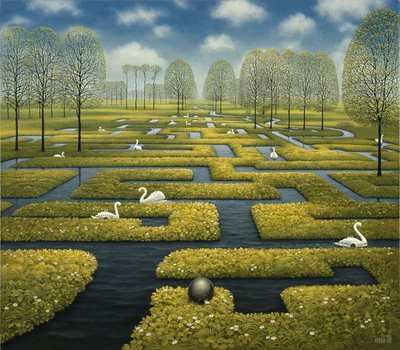
Jacek Yerka’s paintings tend to focus on places and scenery rather than people, and they’re relatively subtle. They rarely have vivid, grab-your-eye colors. But they’re incredibly detailed and just a pleasure to look at. You could lose yourself in those paintings – all but falling into the page – and each time you study them you’ll see something new.

Best of all, these paintings are imaginative and utterly surreal; for instance, take a look at the water maze.


More examples here. These keep inspiring me with ideas for my own work.

4. The Alien Life of Wayne Barlowe, by Wayne Barlowe

Wayne Barlowe does extraterrestrials (Expedition) and demons (Inferno) as well as fantasy creatures. All of them are imaginative down to the last detail: my favorite is the Villar, which is a giant human from the waist down and a castle, complete with multiple towers, in the other direction. In other words, a mobile home of the medieval fortress variety.

5. In Pursuit of the Unicorn, by Josephine Bradley

If you like unicorns, this book is a must-have for your library. As well as about a hundred different pictures of unicorns, there are some beautiful pieces of poetry in this book. And the paintings are lovely – a unicorn trapped in the maze of a roseblossom and a woman with a twisted horn growing from her forehead are the most memorable.

Friday, July 17, 2009

The latest from PublishAmerica


I enjoy reading about vanity presses, but there’s little to be said about many of these since they’re honest about what they are. They also tend to adopt a single method of being paid by authors (e.g. up front, through book sales, etc) and stick to that more or less faithfully.

In contrast, PublishAmerica frequently attempts new tricks and tactics. Most of these are fascinating from a psychological perspective, and I have to give PA credit for sheer inventiveness; there is nothing that this author mill seems unwilling to try when it comes to getting money out of the unfortunate writers who sign up with them.

PA’s business model revolves around selling books to writers, which they do by sending weekly emails offering discounts on bulk purchases of these overpriced books. The shipping and handling for the first book is $4.99, with $2.99 for each additional book. As a PA author puts it,

But it's $4 book shipping. The shipping is a killer.

And it by no means stops there. First there was the auction for advertising space in the backs of other books.

Then there was the sale of framed royalty checks.

Then PA offered hardcover and large-print versions of books. Naturally, many authors were delighted at this news and eager to order copies, especially since hardcovers were the same price as paperbacks. Their joy didn’t last for long, though.

Well I tried ordering a few hardcovers of my book today and was told that I couldn't order any unless it was 9 or more!I think this is a big mistake because,I know everybody would buy at least one of each of their books!

It’s not as cost-effective to PA to sell one or two books at a time. That’s also why there were (and probably still are) problems with ordering hardcover books directly from PA.

On another note, has anyone noticed we can't get to the hardcovers on the PA site? I could yesterday, then when i tried today, it seemed to have disappeared. I'm hoping the site is just "under maintenance"

Let’s not get into what the shipping and handling costs for hardcovers might be. PA claimed that the prices of hardcovers will go up this week, though whether this is true or a ploy to make writers rush to purchase copies isn't clear. Authors do get regular emails offering them a small number of free hardcover books if they order paperbacks in bulk – s & h not included, of course. But then came the most recent twist.

Did anyone get the PA message about changing to a 1-900 to order books? Have any ideas of the $ $ $ that is going to cost? I have never used such a number- very disappointed.

PA’s response was that they would now have a help desk with a 1-900 number, so authors will have to pay to speak to a real person. However, authors can still order books for free.

Future book purchases can be made online, at no phone cost at all, using a special code that will be made available to all authors.

Why won’t this special code be made available to bookstores and readers? Because PA doesn’t want to sell to bookstores and readers, only to authors, and will use any opportunity, no matter how small, to force authors to buy books.

I am in the middle of working on trying to get someone to buy out my contract. The only problem is, I have to retype my book because I lost my original and PA won't send me a new electronic file. They will if I purchase more than 8 copies and then buy the e-book. I don't want an e-book.

I think of this as the vanity press version of the Death of a Thousand Cuts. In and of itself, each individual email or tactic might not result in mondo profits, but put them together and multiply them by the number of writers on whom PA preys, and it amounts to a lot. And since writers don’t even get the two free copies that they used to – PA has discontinued this practice – they nearly always end up buying copies of their own books just to see the product of their labor.

By now there are numerous warnings about PA. Writers still sign up, though – partly because they may not be aware of these problems and partly because the idea of seeing their work in print so easily and at no (initial) cost to them is too strong to resist. But that worm is on the end of a very sharp hook. And PA will keep coming up with ways to bleed whatever is caught on the end of that hook.

Wednesday, July 15, 2009

More thoughts on names


Since my last post was on names that don’t work for me, I thought I’d write a little about names that do. As GunnerJ mentioned, most of those in George R. R. Martin’s A Song of Ice and Fire are well-chosen, especially when it comes to indicating familial relationships. Considering how many characters appear in these novels, the idiosyncratic naming conventions of some of those families help readers to remember who belongs where.

On the other hand, Martin is still careful to distinguish the most important individuals within those families. So even though the Targaryens past have used names like Rhaella, Rhaenyra and Rhaenys, the last Targaryens are called Rhaegar, Viserys and Daenerys. The connections between their names are still clear, but it’s much less likely that the names will blend into each other.

Similarly, although the Frey family often names sons “Walder”, they’re distinguished with some addition to the name. Hence characters such as Big Walder, Little Walder, Black Walder, Red Walder, Bastard Walder and so on.

Speaking of nicknames, these can be tricky. I recently read a story where an alien had a nickname based on the initials of his names after they were translated into English, which would have been fine except for the whole “alien” part. There was no conceivable reason why he would have accepted such a nickname, since he wasn’t at all interested in human culture or trying to blend in.

The antagonist of Dean Koontz’s The Bad Place has a much more interesting nickname. He’s a vicious, unstoppable monster (the antagonist, not Dean Koontz), but a flashback shows that his mother doted on him and called him her “little candy boy” when he was a child. The nickname stuck but grew shorter, so now he’s Candy.

I like this because the origin of the nickname is realistic. And “Candy” is not in and of itself an intended-to-frighten “Look at me, I’m eeeeevil!” moniker – it’s light-hearted and cute, until you read about the sadistic crimes Candy commits. Then his personality brings depth and weight to the nickname, not the other way around. Unfortunately, newer Koontz villains like Vladimir Laputa don’t have that much subtlety and contrast.

Many characters in fantasies have fairly complex names - elves in Tolkien’s novels, for instance - so I like to see these contrasted with shorter, crisper names that may also be easier to remember. One thing I’d avoid doing, though, is restricting such shorter names to an arbitrary number of letters unless there’s a good reason for this. In James Barclay’s Chronicles of the Raven novels, all Protectors have three-letter names, which makes them seem simplistic. And it wasn’t clear whether this was a custom of their society or an authorial decision.

Choosing the best names, according to the bible, is the first thing humans ever did. Maybe that’s why it’s still so much fun. :)

Sunday, July 12, 2009

Five more names that don’t work for me


My main peeve with fantasy names is the sort of name exemplified by Jaelle, Lissar, Aerin, and of course Krystalynne. They sound like names I would have liked when I was five years old and wanted to be a unicorn when I grew up. Very few real names have this sort of prettiness, and that might be because it gets cloying.


1. The Evil Emperor Zurg

I recently read a query for a fantasy novel. The protagonists’ names were something like Jeffrey and Lydia, while the antagonist was called Zarg.

This is going to seem like a parody no matter how you slice it (and the query gave the impression that it was a serious heroic fantasy). Worse, it seems like a heavy-handed parody. And it comes off as a throwback to the early days of space operas where the hero always had a wholesome, All-American name while the villain always had something vaguely foreign-sounding that includes the letters Z, X and possibly Q.

The only way I could see this succeeding would be if the writer showed very clearly that these names were selected with tongue in cheek and with the writer being fully aware of their implications, but using them in an insightful or amusing way. Maybe names in the characters’ world have status based on the initial letters, so slaves’ names always begin with an A while emperors and gods have Z names.

2. Nammmes that are diffficult to pronnnounce

It should have been enough of a warning when I read of an alien race called the “V'ornn” in Eric Van Lustbader’s The Ring of Five Dragons. Repeated consonant, check. Apostrophe in the middle of the name, check. But I kept reading and found names like “Rekkk” and “Wennn Stogggul”.

I’m not sure there’s any way to pull off a naming system like this. The best that could be said of it is that it’s consistent and it’s not something encountered on Earth. Other than that, I think it’s better not to make the reader have to consult the pronunciation guide in the back of the book.

The first time I read Tolkien, I didn’t know that Celeborn was pronounced with a hard C – i.e. “Keleborn”. But I didn’t need to stop reading to figure out how to mentally say the name. And when I read up on pronunciation, it was out of interest in Tolkien’s world rather than because that was the only way to continue reading the book.

3. Moniker indicates alignment

I’ve read books where an evil female character was called Malice (Homeland, R. A. Salvatore) and Mallice (Duncton Found, William Horwood). Then, because I obviously wasn’t thinking too much, I named an antagonist Malis.

This could still work for me, but only in the right context – in a relatively traditional fantasy and when the names are kept subtle. I’d rename “Malis”, for instance, because that signals to readers that this is an evil, evil person. And although she can be, I want readers to see matters from her point of view as well, which won’t be easy with a name that proclaims a quality quite so loudly.

4. Weird nicknames

In Shirley Conran’s Tiger Eyes, the heroine and her husband (who are white and Anglo-Saxon if not Protestants) are called Plum and Breeze.

Even given that these are nicknames, each time I read them they reminded me of haiku. Normally I like exotic names for heroines when I read erotic romances or sex-and-shopping novels. Pagan (Lace, Shirley Conran), Jazz (Dazzle, Judith Krantz) and Blaze (Blaze Wyndham, Bertrice Small) sound fine. More than that, they sound exciting and vivid.

But Plum? Makes me think of a plump, motherly type taking a pie out of the oven. Either that or a character in Cluedo.

5. The Corleones vs. the Harrises

I can’t remember whether I read this in a query letter or a published novel, but it was an organized crime family with the last name of Harris.

Is it possible to have a realistic Mafia clan with the last name of Harris? I suppose so. In the hands of a skilled enough writer, anything’s possible. But really, aren’t there enough challenges already in creating the suspension of disbelief without adding to them?

Tuesday, July 7, 2009

The X and Y of Buy


I confess to being very fond of shopping. When I saw that Thomas Nelson had a new release on why and how men and women make decisions on purchases, I requested it right away through the Book Review Bloggers program, and settled down for what I hoped would be an entertaining as well as illuminating read.

According to Elizabeth Pace’s The X and Y of Buy, women and men operate differently on a psychological level – caused by genetics, by brain structure and chemistry, by millions of years of evolution – and one expression of this is the way that they shop. The book is structured to provide help and advice for salespeople to deal with both kinds of customers.

A man’s approach tends to be direct and finely-focused, while a woman’s approach is more likely to be holistic, taking several factors into account. This is illustrated by a Cautionary Tale of a BMW salesman who tried to sell a car to the author, but dismissed her question about the cupholder, or lack thereof. To him, the important things were the car’s design and performance – the driving experience, in other words. To her, all the other experiences she would have while driving were as important.

And of course, she didn’t like her concern being trivialized.

The book also describes how successful advertising appeals in different ways to men and women. For instance, many ads aimed at men focus on conquering one’s environment. Ads aimed at women, on the other hand, focus on successfully integrating the different parts of a woman’s environment – job and family and self and community.

Finally, the book covers ways in which to communicate when selling to men and women (e.g. whether to nod in agreement or acknowledgment, allow the buyer private time to make a decision and so on). I would have liked a few more memorable examples like the BMW salesman, though. I’m not a businessperson, so I can’t evaluate the book from that perspective, but from a layperson’s point of view, it was an interesting enough read.

When I read books on business, I often try to relate the advice in them to writing (because to me that’s the most entertaining business of all). And one suggestion leaped out at me: an easy way to make sure your product or presentation stays in the customer’s mind is to make them feel strongly about it. Try to make your book or story have an emotional effect on the readers, in other words.

This is something writers of fiction do on a regular basis, but it also applies with non-fiction. Perhaps even more so, if the writers want to reach readers who may not share their interest in a topic or their position on a controversial issue.

Monday, July 6, 2009

Life, not as we know it


I’ve often written about ways to make humanoid creatures as alien and intriguing as possible. But what about creatures which aren’t humanoid, which don’t look like anything we know or expect?

Life not as know it, in other words.

What inspired this post was the trailer for Aeon Flux. I’ve been warned not to watch this movie, but something in the trailer fascinated me – the swarm of ball-bearings that rolls purposefully down a corridor, stacks against a door and blasts it open. I couldn’t help wondering if they were alive. Sentient, even. Were they a group made up of individuals or one mind in several small, identical, spherical bodies?

Wayne Barlowe’s Expedition is another rich motherlode when it comes to truly alien creatures. Barlowe deliberately designed the organisms of the planet Darwin IV to be very different from those of earth, so none of them have eyes. I find myself looking at their heads and searching for a point of reference, something to meet my gaze, but there’s nothing of the sort. Many of them are also monopedal or tripedal – another fascinating difference.

And while I don’t remember anything else about Samuel Delany’s City of a Thousand Suns, I think there was a council scene featuring creatures with thirty-foot eyestalks, beings composed of crystal and others consisting entirely of sound. Whether this is feasible or not, it produced a visual image that’s remained in my head for nearly twenty years now.

It also makes me imagine even more unusual substances that could make up the bodies of such creatures. What about fire? Allow the fire – whether it be a candle’s flame or in a fireplace – to go out, and the creature ceases to exist.

Or rock… no, better yet, mountains. Gives a new meaning to “the hills are alive”. If the mountains of a land were alive, opening their eyes so high above the world that all they saw were clouds, what would they be like? Slow to speak and decide, rather like Ents, since they’ve lived for millions of years and aren’t going anywhere?

Or what if that substance only produced sentience and intelligence when enough of it was gathered together to cross a certain threshold? So a handful of sand – just enough to fill an hourglass – might understand and obey basic commands, but an entire garden of sand would be more than capable of carrying on an intelligent conversation with you. And a desert… well, that would be the silicon equivalent of Stephen Hawking.

Graham Masterton’s Edgewise features the Wendigo, which is two-dimensional, hence the title. This characteristic enables it to slip under locked doors and disappear whenever it stands edgewise. When it stalks the heroine, she’s only able to catch a glimpse of it (and take it aback) by setting up an arrangement of mirrors that reflects it no matter which way it turns. I’d love to see the same thing done with shadows. Shapeless creatures made of shade would be fascinating.

Life, not as we know it.

Friday, July 3, 2009

Five fun things to do with villains


I enjoyed reading the Evil Overlord list when I first saw it years ago, and I’ve always wanted the antagonists of a story to be as intelligent, resourceful, creative and tough as possible. The higher the dice are stacked against the protagonist, the more enthralled the readers will be. With that in mind, here are a few interesting things that could be done with villains.

1. Have him save the heroes at the start.

This could happen before he knows that they’re going to work against him or pose a challenge to him. While he might later be frustrated to realize that he inadvertently helped his enemies, it’s likely to create a problem for the heroes too, since now they’re in his debt. And they’ll lose reader sympathy if they don’t acknowledge what he did.

2. Give him someone he genuinely likes and admires.

This isn’t the Mad Scientist’s Beautiful Daughter, or the James Bond villain’s cat – these are more like prized possessions, stereotypical status symbols who tend to be kept safe from harm. Instead this is a friend or subordinate, preferably the latter since this means the antagonist will have to order him out on missions or assignments, any of which could be his last.

The death of the antagonist’s loyal officer or trusted confidant will carry much more of a punch than a hundred nameless redshirts being wiped out.

3. Let him perform small, casual acts of mayhem or malice.

Make these as amusing as possible, and the readers will perk up the moment the antagonist is on stage. Some villains get sarcastic comebacks, but few of them get to do funny, petty things like using a little magic on the beautiful heroine’s portrait to make one of her breasts look bigger than the other (no, that’s not from any fantasy that’s been written yet; I just thought it up for this post).

4. Give him some unusual detail of appearance or object.

In Tanith Lee’s Delusion’s Master, Chuz, the lord of madness, keeps the jawbones of an ass and uses them as a ventriloquist’s aid, sometimes carrying on a conversation with them. That kind of thing is unforgettable.

5. Make him really, really attractive.

Even when villains are physically appealing, the heroes and heroines are never attracted to them. Either they sense the darkness lurking beneath the fair exterior or they’re so much in True Love with a good person that the villain’s appearance never sways them.

But what if it does? That’s one thing I liked about Matthew Woodring Stover’s debut novel Iron Dawn; when the heroine meets the villain for the first time, she’s literally dry-mouthed and blushing because he’s so handsome. He’s a murderer, a rapist and a pedophile, true. But he’s got amazing beauty and physical presence, and she can’t help feeling the effects of those.

Wednesday, July 1, 2009

How should writers respond to reviews?


Alice Hoffman’s recent, uh, response to a review made me think about writers and negative reviews, and there’s a question I’d like to ask anyone reading this.

We all know that the best response to a review is “Thank you”. Reacting to a negative review by becoming angry or defensive – or worse, trying to enlist fans or fellow authors against the reviewer – won’t change the fact that the reviewer didn’t like the book. It won’t produce good reviews to counteract the negative one. It’ll just establish the author as someone who behaves in a less than professional manner, someone who can’t take the heat.

But what’s the best response if a reviewer misunderstood something factual in the book, or made an error? As a very crude example, let’s say that your character does a firewalk, pacing barefoot over a layer of hot coals. A review says that this couldn’t happen without your character’s feet being burned.

In reality, though, people can do this and escape serious injury because the coals are covered by a thin layer of ash that doesn’t conduct heat. As long as the people are walking briskly, it doesn’t hurt them.

So, would you respond and mention this, or include a link to the information?

On a concluding note, yesterday I reviewed a novel printed by the infamous PublishAmerica, and my review was pretty blunt about the problems that an actual publisher should have corrected. The author responded to thank me and let me know he found the review helpful. That’s a classy, professional response, and I hope his next book does very well.