Showing posts with label reviews. Show all posts

Sunday, March 1, 2015

The Odessa File


I enjoyed Frederick Forsyth’s The Day of the Jackal so much that I looked forward to reading The ODESSA File. Plus, that was about a reporter hunting down a Nazi, and I’m a World War II buff. How could such a story go wrong?

In six words: the hero and the hit man.

But I’ll start with the good parts. The story begins when Peter Miller, a reporter who writes about pop bands and juicy scandals, discovers that an old Jewish man, a Holocaust survivor, committed suicide. One of the things the old man left behind is a detailed diary of his time in the concentration camp Riga, and Miller reads this.

Horrifying though the man’s experiences were—at the hands of the camp commandant, Eduard Roschmann, the Butcher of Riga—they aren’t why Miller decides to hunt down Roschmann. That’s personal, and it’s a great twist. I liked how it leaves Roschmann and his Nazi colleagues confused as to why they’re being tracked down by a young German with a war hero for a father. Mossad agents they’d expect, but not this.

Miller’s investigations draw the attention of Odessa, a secret organization of Nazis which works to get people like Roschmann to safety, and one way they do this is with forged passports. The forger maintains a file of all the people to whom he’s issued fake documents, and this file is his way of making sure Odessa never feels he’s outlived his usefulness. To safeguard him, Odessa sends a hit man to deal with Miller.

But they aren’t the only people who have noticed Miller. Another secret organization—of concentration camp survivors turned Nazi hunters—gets Miller to safety and tells him how to get into Odessa. After an intensive crash course, Miller can pass himself off as an officer who once murdered people in Flossenburg. He goes to one of the higher-ups in the Odessa and asks for help getting a new identity.

So far, so good. The tension is ever-present, the stakes are high, and Forsyth’s research is detailed. Then it all unraveled.

The higher-up sends Miller to stay with another Nazi, Franz Bayer, who’ll arrange for the forger to supply a fake passport. Claiming he had to go on the run for fear of being discovered, Miller has no money other than the handout the Odessa man gives him for the train fare to Bayer’s house. But because Miller doesn’t want to take public transportation, he drives there in his Jaguar.

I repeat : he drives there in his Jaguar. Which the Odessa know all about, because they’ve done their own investigating.

Granted, he doesn’t park it in Bayer’s driveway, but he still gets spotted by Frau Bayer (who doesn’t seem to wonder at this poor broke man driving a Jaguar, but then again, the few women in the story are not characterized by their powers of deduction). The Odessa higher-up immediately alerts the hit man.

Here’s where Miller now gets saved twice by dumb luck (or authorial fiat, since as the hero, he can’t die). The hit man prepares a bomb that he wires under the hood of the Jaguar, and he also waits to sniper-shoot Miller. Instead, he accidentally kills Bayer, and the bomb destroys the Jaguar—when Roschmann’s bodyguard has taken the car and is the only person inside.

At this point, I expected the Odessa people to shoot the hit man before he could bring down their entire organization.

Miller’s aura of immortality preserves him to the end, and the hit man is put out of his misery. I thought wistfully of how competent the Jackal was, and went to re-read that book instead.


Tuesday, December 16, 2014

I'm on QueryTracker and Smart Bitches!


I wrote a review of Betsy Lerner's The Forest for the Trees: An Editor's Advice to Writers, a memoir of publishing and a great look at the business from the other side of the desk. Check it out on the QueryTracker blog here!

A slightly less complimentary review (heh) was the result of my reading Anne Stuart's historical romance Breathless, and I sent that to Smart Bitches Trashy Books when I discovered they had a collection of rants from readers. So here's my rant. Enjoy!


Sunday, October 19, 2014

Bloodchild


I’ve always been fascinated by alien races which parasitize humans.

This never gets old, because it can be written in so many ways—the aliens could be like the souls of Stephenie Meyer’s The Host, and genuinely believe they’re in the right. They could be like the creatures in the Outer Limits episode “The Surrogate”, which change pregnant women from the inside out. The sky’s the limit.
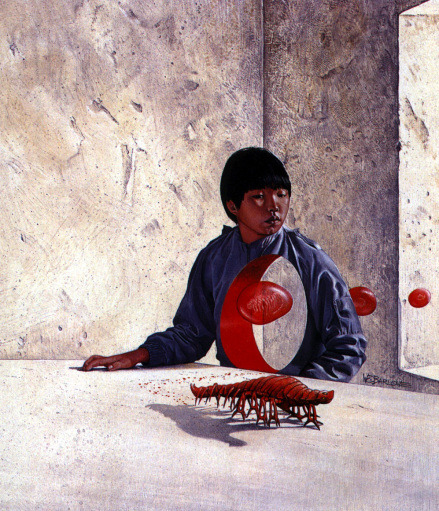
What intrigued me about Octavia Butler’s short story "Bloodchild" was the painting it inspired for a cover:


Children, being specifically targeted by the aliens. That was new. So once I found a copy of the collection Bloodchild and Other Stories, I settled in for (what I thought would be) a chilling read.

The premise is simple. Humans live on another planet in what’s called the Preserve. They coexist uneasily with the natives of that planet, the Tlic, who have multiple limbs, stings and a lower body temperature. They’re intelligent, but they’re wonderfully different from humans.

T’Gatoi whipped her three meters of body off the couch, toward the door and out at full speed. She had bones—ribs, a long spine, a skull, four sets of limb bones per segment. But when she moved that way, twisting, hurling herself into controlled falls, landing running, she seemed not only boneless, but aquatic—something swimming through the air as though it were water. I loved watching her move.

Tlic males mate and die, but the females live to adulthood and lay eggs. Here’s where the humans come in, since the eggs have to be laid in hosts, and the size and strength of the resulting Tlic depends on the kind of host. Having the eggs introduced isn’t difficult, since the Tlic females release a fluid that relaxes the host, but what’s painful, terrifying and potentially deadly is the hatching. The grubs eat anything except the flesh of the Tlic who laid them, so if they’re not removed from the human in time…

This could have been an excellent horror story by itself. What makes it deeper and more intriguing is T’Gatoi’s relationship with Gan—the human narrator—and his family. His older sister, Xuan Hoa, wants to be a host. His mother is torn between her friendship with T’Gatoi and her need to protect her children. And T’Gatoi tries to balance her biology, the demands of other Tlic, and her fondness for Gan’s family.

This is one of those stories that can be read again and again. I loved the dual meaning of “host”, the complex ever-changing interplay between humans and Tlic as groups, and the different attitudes to being parasitized. I liked how Gan grows up in the course of the story. When he refuses T’Gatoi’s eggs and uses a rifle to show how strongly he feels about it, she makes it clear this has to be his choice.

“How could I put my children into the care of one who hates them?”

The utter alienness of the Tlic is beautifully balanced out by this, and the ending is quiet but emotional. I only wish Butler had written more stories set in this world.


Saturday, October 4, 2014

Wild Oats


The first interesting thing about Jedwin Sparrow is that he’s a mortician. The second is that he wants to sow some wild oats—and there’s only one woman, a divorcee five years his senior, who might be prepared for some… planting.

Pamela Morsi’s Wild Oats, set in the early 1900s in the small town of Dead Dog, Oklahoma, kicks off the romance with a great start. Jedwin makes the most endearing indecent proposal ever; not only is he nervous, but he offers some financial compensation. Since the divorcee, Cora Briggs, clearly doesn’t receive any money from her ex, Jedwin suggests he repair her fence and provide her with a “modest stipend” for her “discretionary use”.

Cora is nowhere near the scarlet woman the town believes her to be. She could use the money, because she barely manages to feed herself by selling preserves to the local shopkeeper—who knows she has no choice but to accept a pittance in return. But she does have her self-respect. So as Jedwin stammers out what he hopes to receive in return, she begins to tell him to leave her house.

And then she changes her mind. Because Jedwin’s mother is one of the respectable matrons who spread nasty rumors about Cora after her divorce, and although she’s not a malicious person, Cora imagines how horrified Mrs. Sparrow will be if her precious little boy has anything to do with the town harlot.

Cora won’t seduce him, of course. She’ll just play along. So she tells him she’ll allow him to court her, because even women like her enjoy flowers and poetry prior to seduction. What she doesn’t expect is for Jedwin to take her up on it. As the mortician, he’s learned how to preserve flowers, and his attempts at poetry are funny but genuine. She begins to like him, and Jedwin soon feels something deeper even than attraction.

But one by one, the townsfolk slowly suspect a harvest of wild oats is growing under their noses. And Cora knows the dalliance can never come to light—not least because of the secret she has to keep from everyone, the truth about why she was divorced.

Pamela Morsi’s Americana romances tend to be feelgood reads, and Wild Oats is no exception. Her characters are down-to-earth, flawed but good at heart; I especially like the fact that Cora’s ex-husband is not demonized. He didn’t abuse her or leave her unsatisfied in bed; he just, for a good reason, was not in love with her.

I liked everything about this book, from Jedwin’s unusual profession to the fact that Cora was curvy, older and more experienced. Not to mention determined to manage for herself, even if she had to scrimp and do without. This isn’t a heart-wrenching romance, but it’s a very pleasant read and I hope I find the sequel, Runabout, so I can visit the town of Dead Dog again.


Wednesday, September 10, 2014

House of Stairs


If you are ever forced to choose which futuristic dystopia you’ll live in, that of The Hunger Games or that of William Sleator’s House of Stairs, please, please pick Panem. Even if you’re chosen as a tribute, the worst that will happen is that you’ll die.

And what’s really scary is that Sleator’s book was written in 1974.

The story begins very simply. Sixteen-year-old Peter, an orphan living in a state home, is blindfolded and taken elsewhere. When he’s allowed to see again, he’s in a vast white room filled with nothing but stairs.

Without railings they rose and fell at alarming angles, forking, occasionally spiraling, rising briefly together only to veer apart again, crossing above and below one another, connected at rare intervals by thin bridges spanning deep gulfs.

I love bizarre houses, mazes and strange testing grounds. This is all three.

Left to his own devices, Peter would close his eyes and wait for punishment, but he quickly meets another teenager, Lola. A juvenile delinquent, she’s got all the toughness he lacks, and they discover the one source of food in their new world. Located on a landing, it’s a machine which dispenses pellets (cooked meat, though neither of them are used to that) when they do what it wants them to do.

One by one the other involuntary participants in the experiment—handsome, manipulative Oliver, uncertain Abigail and Blossom, who’s the most dangerous—gravitate to the food source. From there, the five of them try to make sense of what’s happened. The machine quickly conditions them to do a repetitive dance for their meals—and never quite dispenses enough for them to be satiated.

Once that foundation has been laid, though, the machine slowly but inexorably rewards them for a whole new set of behavior patterns—harming each other. Here’s where the nightmare really begins.

I’m not going to spoil the ending. I’ll just say that while no one dies, what happens is not at all predictable, and the horror grows to Lord of the Flies-esque proportions. And then the experiment ends, so I breathed a sigh of relief—except for the denouement and explanation that unfolded in the epilogue. Which was even more horrifying, because it shows what the United States has become (this is why even Panem would be preferable) and because it ends with a six-word sentence that is utterly chilling.

At least with the Hunger Games, if you won, that was a good thing. You could go home. Not so here.

If you’re getting burned out on YA dystopias, you need to read this. No love triangles—no romance, period—just a meticulously crafted psychological thriller. House of Stairs is unforgettable.

Saturday, August 16, 2014

On Writing Romance


Leigh Michaels’ book On Writing Romance: How to Craft a Novel That Sells is a good starting-point for someone interested in writing in this genre, but it also has a few problems that make it a book I can’t recommend.

The book begins with a description of the various sub-genres of romance—and includes gay and erotic romance, which I liked. Michaels goes into detail how to research romances, especially those which depend on a background authors might not be familiar with, and I enjoyed reading this.

The chapter on characterization didn’t offer anything new, though I didn’t disagree with it until I read the list of questions at the end, intended to help writers “get to know” their characters.

What astrological sign was he born under? What kind of music does he enjoy?

Maybe it’s just me, but I’ve never found this kind of “what’s her favorite color” list useful, unless the story will involve colors in some way.

The chapter on conflict was great; I especially liked how Michaels differentiated between the short-term problem which brings the hero and heroine together, and the larger picture which keeps them apart. Not to mention the ways a writer can (inadvertently) sabotage the relationship.

What sank the book for me, though, was the section on dialogue, titled “The Battle of the Sexes”. Well, at least it gives fair warning. This is how you’re supposed to “make your heroine’s dialogue more realistic if you’re a male writer”, because us female writers have that down pat, so we get the section on how to write the hero’s man-talk instead :

Check for aggressiveness (bolding in the text—Marian). Women tend to be indirect and manipulative; even an assertive woman usually considers the effect her statement is likely to have before she makes it. Can you add questions to her dialogue, or add approval-seeking comments and suggestions that masquerade as questions?

When I read this, I turned to the start of the book to check if it was published in 1980. Nope, 2007.

Can I push my assertive, direct heroines into some shy, mealy-mouthed mold? I’m trying to imagine Captain Lera Vanze in my novel The Highest Tide (out from Samhain next year, yay!) saying, “If Seawatch finds out you coerced a seventeen-year-old operative of theirs into a dangerous mission where he was captured and murdered, no one in Dagran waters will be safe. So if you don’t mind, would it be all right if I tried to rescue him?”

Maybe if she was being sarcastic. Lera doesn’t need anyone’s approval. Nor do Yerena, Miri, Alex or any other heroines of mine.

But apparently, what’s self-confidence and competence in a man is aggressiveness (such an unattractive quality!) in a woman.

Check for emotions. Women tend to bubble over with emotion, with the exception that they’re generally hesitant to express anger and tend to do so in a passive or euphemistic manner. If you need your heroine to be angry, can you give her a really good reason for yelling?

My heroines don’t yell. They draw their blades, summon a great white shark out of the ocean, learn to use magic, or figure out other people’s secrets and exploit those ruthlessly.

Just finding these sections to quote annoyed me all over again. Which was a pity, because the last chapter, on revising a manuscript, is helpful and I didn’t notice anything too sexist there. So if you can ignore the part on dialogue, or if it doesn’t bother you, this book could be useful. For my part, though, On Writing Romance won’t be joining my keeper shelf.

Saturday, June 14, 2014

Passionate Ink


I like reading books about writing, and erotic anything is a hot genre these days, no pun intended. So when I saw Angela Knight’s Passionate Ink: A Guide to Writing Erotic Romance, released by Loose Id, I had to give it a try.

This book is ideal for writers new to the erotic romance genre. The author explains the distinction between romance (which relies heavily on sexual tension) and erotic romance (where the characters are having sex, and plenty of it). Under those circumstances, something else will have to keep the characters apart—either their own personalities or some external conflict, or both.

There are plenty of examples from the author’s books, with the author adding notes throughout to show what she was trying to do in terms of intensifying conflict and deepening the relationship. I also appreciated the warning about what can happen if you tease your readership too much. The more you build up the anticipation leading to the sex, the better that needs to be.

The example given here is of one book where this buildup lasted for hundreds of pages. When it finally did happen, it didn’t last very long (due to the author, not due to the hero) and the impression that gave was of an author who wasn’t really comfortable with writing about sex. Hence the protracted teasing which lead up to a fizzle. Personally, I’m fine with fade-to-black in novels like Gone with the Wind, but yeah, if I pick up a hot romance I want heat.

Another such EroFail is when the sex is too emotionally heavy—for insstance, one of the characters is severely scarred from rape. This can work great in other genres. But in erotic romance, the reader expects lots of exciting sex. If the sex comes off as difficult or heartbreaking because of the characters’ physical/emotional wounds, this might be tough to pull off.

One thing I didn’t like about this book was the author’s heavy reliance on alpha males—basically, 200-pound guys who sweat testosterone, who are always ready for “a fight or a fuck”. Even if these are common in erotic romance, I would have loved to see more nuances here. I’m not asking for a man who’s shy or passive. I just want to see someone who would rather outthink the villain than outfight him.

But I did appreciate the her suggestions for how to write an erotic novella or a short story. There really isn’t much room here for the hero and heroine (or other hero) to meet for the first time, so it helps if they have a past history, especially a past romantic history. I used to wonder about whether a romance could be compressed into a short story a la Ellora’s Cave’s Quickies, and this went far towards answering that question.

The book also includes notes on fight scenes, medieval battles, the difference between plate and mail and why the designs of swords changed—which I wasn’t expecting. It’s an unexpected bonus in an erotic-writing book.

From a physics standpoint, a gun that could send somebody flying would also send you flying in the opposite direction when you fired it. So resist the urge to knock somebody through a plate glass window with a bullet.

But it looked so amazing in Blade Runner!

Finally, there’s an appendix of non-fiction books dealing with sex, BDSM, etc. I didn’t go through this in any detail, but that’s because this is a very comprehensive book that covers a lot of angles, which meant I needed to finish it quick and return it to the library. Not a gotta-have-it-forever keeper, but definitely an engaging and useful read.

Tuesday, March 11, 2014

Writing Irresistible Kidlit


I like checking out how-to books on writing, and Writing Irresistible Kidlit is by (former) literary agent Mary Kole. Although I don’t write MG or YA, I felt sure there would be ideas and techniques that would apply to adult fiction as well.

Well, there are, but I’d definitely recommend this to anyone wanting to write for children or teenagers. It’s a great resource. One chapter is devoted to understanding the mindset of these readers. What level of complexity are they looking for when they read? What themes would be too heavy to introduce directly into MG, and what to do under those circumstances? Male or female protagonist?

The book describes the “big ideas” behind some of the most popular YA fiction, cliché openings, grabby openings, characters and plots, along with input from other agents and editors giving examples of what didn’t work for them. Kole even makes a good stab at analyzing the elusive “voice” – how the words used, the emotion in them (or lack thereof), dialect and even repetition of certain words contributes to a highly individualistic result.

Voice for kidlit readers needs to be fresh, electric and immediate, in order to reflect their lives. Never let passive construction (“The party was being attended by teenagers”) sneak into your work.

What I enjoyed most, though, were the quotes from novels. I don’t read a lot of YA and MG, but with this book I got an intriguing cross-section of the best of them (nothing with vampires or werewolves, too, which was a plus for me). This book made me curious about Laurie Halse Anderson’s Wintergirls, and that’s one novel well worth reading. I’m also going to check out Jenny Downham’s Before I Die, although I usually don’t read books about cancer. This one just sounds too intriguing.

So if you’re thinking about writing for children or teenagers, check this book out. It’s a great starting-point.

Tuesday, January 7, 2014

Wintergirls


I don’t usually pick up books where eating disorders play a major role, but I read some quotes from Laurie Halse Anderson’s YA novel Wintergirls in a guide called Writing Irresistible Kidlit. The style was intriguing and I ended up buying myself a copy. It’s just that good.

The story begins when eighteen-year-old Lia finds out her best friend Cassie has died. Which would be bad enough, but on the night of Cassie’s death, she called Lia 33 times. Lia didn’t answer, because they’d fallen out by then.

Which would be worse enough, except Lia knows what killed Cassie—her bulimia, and the pact they made when they were close as sisters, to be skinniest together. Lia chose not to eat at all. Cassie took the other route, but both roads are leading to the same place.

Living with her father and stepfamily, Lia hides the evidence of her worsening anorexia from them as she tries to deal with Cassie’s death. Of course things get even darker, since Cassie appears to her at night—a ghost? a product of Lia’s guilt? It’s up to the reader to decide—and Cassie is lonely.

She wipes a snowflake off my cheek. “You’re not dead, but you’re not alive, either. You’re a wintergirl, Lia-Lia, caught in between the worlds. You’re a ghost with a beating heart. Soon you’ll cross the border and be with me.”

As the year deepens into winter, where it’s easier to hide weight loss under layers of clothes, the voices in Lia’s head and everywhere else grow more difficult to silence. That’s when she starts cutting herself too. This part is disturbing to read, written though it is in elegant poetryesque descriptions. Though it doesn’t last long, because the house of cards comes tumbling down.

Finally Lia runs away to the motel where Cassie died, where she has to face her fate—and either give in to it or walk out of the woods somehow.

We held hands when we walked down the gingerbread path into the forest, blood dripping from our fingers. We danced with witches and kissed monsters. We turned us into wintergirls, and when she tried to leave, I pulled her back into the snow because I was afraid to be alone.

This book is filled with vivid, evocative passages like that. At times the prose is stark and bitter, at others a dreamy stream of consciousness. Once or twice it gets repetitive in a trying-too-hard way, but for the most part it’s incredibly effective. Anderson is a consummate stylist, and I loved the fanciful or terrifying descriptions in the story.

I loved the symbolism, too. That ranges from pomegranate seeds to Pandora’s box to fairy tales—especially the kind with glass coffins. Pick it up for the style, but stay for the story. It's an unforgettable read.

Friday, December 13, 2013

Be A Sex-Writing Strumpet


What I like most about Stacia Kane’s Be a Sex-Writing Strumpet is that it desensitized me. Completely and utterly popped my mental cherry. After you have read the word “cock” a hundred times, even a Catholic upbringing in a Muslim country can’t make you feel awkward about your sex scenes.

Of course, there’s much much more to the book than that. But the most important thing about it, for me, was that it got me over that hump. No pun intended.

The book is a collection of 24 essays originally published on Stacia’s blog, and although I believe they’re still there, I wanted a copy in physical form. Plus, someone who writes such helpful material deserves to have her book bought. So I got a copy for Christmas last year and it was the best present ever.

I also like how sex-positive this book is. It might seem really obvious that a book with this title would be pro-sex scene, but I’ve come across a lot of writing advice urging people not to describe sex in any detail. Fade to black, summarize, describe it in terms of elegant metaphors, but don’t mention body parts and all that crude unpleasant stuff.

Well, if you want to write a hot or erotic romance, you won’t get very far with that approach. Instead, Stacia shows how to keep the sex scenes an integral part of the relationship and the story—while still being explicit and spicy. The essays even include lists of different words for the sex organs, which was really helpful. It was the first time I’d seen such a list presented seriously, instead of in an amusing collection of purple-prose terms from romance novels (not that there isn’t a time and a place for that too). Plus, I like the discussion of graphic vs. mild and how this needs to be reflected in the story as a whole.

The mechanics of sex, the tone of the writing, even symbolism—it’s all covered here, with detailed examples from Stacia’s work to illustrate points. I think my favorite was the list of unusual places her characters have had sex, because those inspired me to try to be more creative.

If I had a complaint, it would be that this book doesn’t cover enough. I would have liked more discussion of menages, BDSM, etc. A few less-than-positive reviews on Amazon also mentioned the style, which is very breezy, informal and personal (i.e. there are several mentions of Stacia’s preferences in sex scenes, which works for a blog but not so well for a book). But on the whole I enjoyed the book—and I keep it on hand if I ever need help with a sex scene.

Thursday, November 21, 2013

No Gentle Love


From time to time I pick up a romance of the overwrought bodice-ripper variety. They’re guilty pleasures, the literary version of cotton candy. I don’t have to think and I know I’m not going to feel anything but amusement, so I settle down to enjoy the ride.

In the case of Rebecca Brandewyne’s No Gentle Love, the book was even better than I expected, but then one scene (which I’ll mention later on) completely derailed it. First, though, the characters. All you need to know about them is:

He’s arrogant, jealous, violent; an earl, a ship’s captain and a highwayman; incredibly handsome, incredibly talented, incredibly rich; capable of killing any man and seducing any woman. Oh, and he’s determined never to love. No reason for this is ever given,

She’s innocent, naive, incredibly beautiful, incredibly feisty, incredibly spineless and capable of attracting any man within fifty feet of her without doing a thing.

And does this book have it all!

  • Forced marriage due to I-want-grandchildren-damnit ancestor’s will stipulation
  • At least two insane villains who lust after the heroine
  • A miscarriage due to a suspicious fall down stairs
  • Amnesia
  • Suicide
  • Murder
  • Two jealous ex-mistresses of the zero
  • A trip to an African village, complete with tribal chieftain who lusts after the heroine
  • A trip to exotic India, complete with a Maharajah who lusts after the heroine
  • A trip to the mysterious Orient, complete with foot-binding, fortune-telling Chinese. But none of them lusted after the heroine. Maybe they thought they were in a different book.
  • And rape on every other page.
    I expected the zero of this novel to repeatedly rape the heroine, because hey, the book was published in 1980 and I’ve read Brandewyne before. But wow. He also slaps her several times, bites her and forces her to perform oral sex on him:

    …he forced her head down. He groaned with pleasure as her swollen lips closed over his heated pride.

    Described in the purplest of prose, their relationship proceeds in a predictable cycle throughout various international locations:

    • They are separated
    • She believes that he’s dead or that she’ll never see him again
    • She is either raped by another man or allows another man to seduce her (yet never feels the world-shattering ecstasy that she knows only in his arms)
    • They are reunited
    • He’s furious that she would allow another man to touch her
    • He rapes her while she sobs, shrieks or scratches at him, but of course it feels amazing
    • Rinse and repeat
    The crowning moment of hilarity, for me, was when the heroine was tied up by one of the insane lecherous villains with her hands behind her back. While the villain was gloating in front of her (probably twirling his mustache as he wished the railroad had been invented so he could tie her to the tracks), her puppy got behind her and chewed through the ropes around her wrists.

    And this was an ordinary puppy, mind you, which had never done anything similar before. I felt like I’d wandered into a Tintin comic by mistake.

    I would be able to recommend this novel wholeheartedly for any readers wanting to enjoy the silliness, except for one particular scene. Remember the black chieftain who lusted after the heroine? Well, he kidnaps her (get in line) and takes her to his village, but she escapes. The zero and his loyal men storm the village shortly after, only to be told that she’s lost in the African jungle and probably dead.

    So the zero drops to his knees screaming at the sky — as you do — while his men kill everyone in the village. After raping the women, that is. Then they walk off, and the author describes how a child who’s survived the slaughter crawls out of cover, sits among the corpses and cries. The chapter ends.

    That came close to being the most disgusting thing I’ve read in a romance novel. Though with the zero being a misogynist (he despises all women) and a classist (he sneers at a suitor of the heroine because the man is a doctor, meaning he actually has to work for a living instead of being an earl), he might as well be a racist too. So I can’t recommend this novel even for readers just looking for ridiculous, campy fun.

    Oh, and one other reason I wanted to read this book was because the zero is the captain of a ship, and I’m in love with all things nautical at the moment. Well, they’re on the high seas and there’s a terrible storm that leaves the heroine cringing in terror, but after it’s over the zero tells her everything’s fine, they just lost a mast which can be replaced. This is like coming in from a battlefield and saying, “Hi honey, I’m fine, I just had a leg chopped off. It should grow back, right? I can haz sex now?”