


Saturday, May 10, 2014
The soulmate trope
There are a lot of romance tropes that I can take or leave, but for some reason, this one gets under my skin. Maybe because it has the potential to be fascinating, but so often it leads to romances with glaring power imbalances, or where there’s no real conflict once the hero and heroine meet each other. Because, after all, they’re soulmates so that means they’re perfect for each other.
For the purposes of my mini-rant, I’m going to define “soulmate” as someone who’s been destined for the main character, rather than someone who’s right for them but who hasn’t been preordained as their only choice by some higher power. So here are the problems I have with the trope, and a few ways to fix them.
1. Everyone else is automatically inferior.
No matter how much they care about the protagonist or how much he/she loves them, every other person they might be involved with is shown to be inferior or is forced to step aside when the soulmate shows up. In one case, the author flat-out made it clear that only a designated soulmate could actually love the protagonist.
Of course, that raised the question of whether the protagonist was naturally unlovable, such that someone had to be preprogrammed to care for him. Solution: don’t denigrate freely chosen love to make soulmates a more attractive choice (or the only choice). I’d love to read a romance where the hero found his soulmate, except she was happily married to another man and wanted to stay that way, even if she was with the hero too. Hey, menages are popular these days.
2. Obsessiveness or unhealthy controlling behavior on the part of either person is excused.
In two different stories I’ve read, the hero is a powerful immortal being while the heroine is an ordinary mortal. Fine, I’d prefer them to be on a more equal footing but I’ll go with this. But then I find out that, knowing they were soulmates, he watched her from the time she was a baby until it would no longer be statutory rape (under US law, of course, never mind the time and place of the story) for him to make a move.
This might have been presented in an "I'm watching over you like a sexy guardian angel" way, but I don't find it romantic. It's a violation of privacy. I mean, did these men even look away when the little girls took a bath?
Still, this works for some readers, because not everyone thinks it was creepy of Edward to watch Bella while she was sleeping.
3. “The universe will put a gun to my head if you don’t love me.”
In other words, unless the MC finds his preordained love interest, he will go insane, turn evil, be stuck in wolf form forever, etc.
For me, this puts far too much pressure on the love interest. I wouldn’t date a man who said he would die unless I did so—I’d think he was desperate or mentally unbalanced. Even if I had proof that yes, he would die without my affection, I’d admire him much more for trying to find the root cause of his problem, rather than sticking me as the Band-Aid over it.
This is my biggest problem with all soulmate stories where the failure to find a soulmate means insanity or death. Why has no one ever attempted to investigate this phenomenon, much less change it? These days, scientists are even studying the causes of aging, to see if lives can be extended, so you'd think that if everyone knows they have death or worse hanging over their heads, they'd try to investigate it or look for a third option.
If they don’t, either the author has created the most fatalistic, incurious population ever. Or they've all read the script and know they’ll be provided with a love interest.
I'd love to see a soulmate story where someone didn't accept that the rules were carved in stone. It would be awesome if the hero and heroine, without the usual insta-love between them initially, worked together to find a solution and fell for each other along the way.
4. No real exploration of what it means to be a soulmate.
If there’s some higher power handing out soulmates, what’s the reasoning behind the choices this higher power makes on behalf of the protagonists? It’s easy to say “a soulmate is someone who will love you and make you happy”. But that just raises the question of how this is different from someone you meet on your own, someone who doesn’t have a star on their forehead that lights up when you meet them, but who admires you and cares about you anyway.
For instance, is a soulmate someone whose personality matches yours or complements it? Does a soulmate think the same way you do, so if you’ve decided not to have children, the soulmate doesn’t want to have children either? But say you change your mind later. If the soulmate obediently goes along with the new decision, then they’re not a different person—they’re your reflection in a mirror.
On the other hand, if the soulmate has their own goals and needs, some of which conflict with the protagonist’s in a way that’s not easily resolved, that could be interesting. This would be a great example of the trope being used the right way—to bring the hero and heroine together, but as the start of the conflict rather than the end of it.
Tweet


Tuesday, May 6, 2014
Sharkpunk bookmarks
These were fun to make, and I can include them with giveaway copies of The Deepest Ocean
 .
. 

Not sure if the tiny fish who's in some of the bookmarks is a pilot fish or a snack.
On a completely unrelated note, the Cover Cafe's 2013 contest entries are up. My favorite category is always the Worst Cover, and this time there are some genuinely freaky ones, like the woman with the two mannequins or prosthetic-less Borg. Check them out and vote!
 Tweet
Tweet
Saturday, May 3, 2014
Teeth in fantasy
Teeth are an easy way to distinguish and learn about different species, but how to use them in fantasy?
Types of teeth
Grazers have flat-topped teeth to grind down the tough parts of plants. Carnivores have sharp incisors and canines to slice through flesh. Gnawers, like rodents, have teeth that constantly grow. The crocodile’s teeth and jaws are designed to grip, so that when it dives underwater, it drags its prey with it and quickly drowns the other animal.
Teeth can be large and spectacular in appearance as well – such as the tusks of a walrus or an elephant, or the large fangs of a saber-tooth. And finally there are the hypodermic needles of venomous snakes. Any of these could come into play when designing a new species of people or animal in fantasy.
Fantastical teeth
Not many SF races have different dentition. One exception is the Tilari of F. M. Busby’s The Demu Trilogy
 , who have forty teeth which ate correspondingly smaller to fit into their mouths. And of course, there are any number of paranormal races with fangs.
 The Mouth of Sauron, in Peter Jackson’s The Return of the King
 , is a great example of this. Just making his mouth twice as large and giving him rotting fangs to match = instantly disturbing. People with circular rows of teeth, like lampreys or cookiecutter sharks, would be even worse.
 Teeth in a fantasy world don’t need to be made of enamel. Metal teeth might remind readers too much of Jaws from the James Bond films, but there’s a character in A Song of Ice and Fire
 who has wooden teeth. Stone might work as well—or how about taking useful teeth from animals and implanting them in a character’s jaw?
Going one step further than this would be teeth that changed depending on what the person needed at the time, from injecting venom to opening a can of peas without the assistance of a can-opener. Dentition is used as forensic evidence, but in this situation it couldn’t be trusted.
Uses for teeth
Once they’ve been removed, there are several purposes they could be put to. Jewelry. Weapons. Armor with overlapping rows of sharks’ teeth. Tools, such as the large molars of giant herbivores as pestles or grinders.
Or for something more fantastical, how about a secret method of assassination? Mix tiny teeth in with cooked rice, or with something that’s likely to be swallowed whole without chewing. Once these teeth are inside a person’s stomach, they jab into the nearest surface and burrow in. Death from peritonitis occurs soon, and short of an autopsy, no one will know why.

Tweet
Tuesday, April 15, 2014
The Lovely Bones


If you’re not a fan of the book, there are only two reasons to watch The Lovely Bones
. One, Saoirse Ronan’s acting. Two, the CGI. Everything else is… well, I’ll get to that. The story is straightforward. Fourteen-year-old Susie Salmon is lured into a hideaway by a neighbor and killed there, but her spirit, from heaven, watches as her father and sister try to find out the truth and slowly put their lives back together. The theme is one of accepting what we can’t change, relinquishing what we can’t have and learning to let go. But in a happy way, because there’s something good ahead.
Saoirse Ronan is a talented actress, and it’s difficult not to like her as a teenager who’s by turns exuberant, shy, annoyed with her parents and filled with dreams—typical, in other words. And the scene where Mr. Harvey meets her in the cornfield and persuades her to check out a cool underground room is very tense.
Stanley Tucci’s performance as George Harvey is… mostly good. A bespectacled middle-aged man, he’s the embodiment of the phrase “banality of evil”. What I found a bit difficult to buy was the way he babbles and giggles once he’s lured Susie down. I get that he’s excited (while Susie quickly realizes something’s wrong) but he’s more scary when he’s calm and serious.
What I also found difficult to buy was that he excavated this room in a field in winter and no one noticed. There’s a shot of him digging at night, but it’s still an elaborate feat of secret construction. Still, the best way to enjoy this film is not to think deeply. For instance, if I went to my personal heaven (a limbo meant for people who haven’t yet moved on), I would want to be with people I cared about. Instead, Susie gets Holly, a girl who appears out of nowhere and who tells Susie nothing about herself, but who becomes Susie’s BFF.
If you’ve ever watched Mary Poppins
 , remember the scene where they go into the chalk painting? Something similar happens here. With her new pal, Susie romps through a magical landscape that keeps changing to entertain her. No lingering trauma from murder, no attempts to change anything or tell her family the truth.
 And it’s clear that she can influence the occasional event on Earth, if she tries hard, but her major accomplishment there is to put herself in a living girl's body so she can finally kiss the boy she likes. Meanwhile, just outside, Mr. Harvey disposes of the safe containing Susie’s body, which she knows about. Yet the kiss is more important.
I suppose that was part of her acceptance-and-letting-go, to not care about her body… but wouldn’t her parents care? Wouldn’t they want her remains to be laid to rest with dignity, rather than never even knowing where she might lie?
But, like I said, don’t think too much. Or you might wonder, if the real heaven is a place where there’s “no memory”, is there a blank in your mind when you try to think of how you got there? And it’s clear that Susie’s heaven is influenced by other victims of Mr. Harvey’s, which leads to a truly schmaltzy scene where all of them come smiling out of the horizon while the music swells.
I did get teary when the little girl—the youngest victim, who’s six—gives Susie an evaluating look, then smiles, runs up to her and hugs her around the waist. But then I wondered, is that girl going to stay six years old for ever? An eternal child, frozen at the moment she died? Anne Rice did that more realistically with Claudia in Interview with the Vampire
 .
. I understand why the joyous get-together, since there was a previous scene when Susie’s heaven showed her the corpses Harvey had discarded, so Jackson had to assure the audience that these women and girls are now frolicking in paradise. Plus, they’re all friends together in a Raped-N-Murdered club.
But back on earth, Susie’s father is ham-handed in his attempts to find her killer and to stop Harvey, whom he suspects despite having no evidence. So her sister breaks into Harvey’s house to find some. This is the second tension-filled scene in the film, though I have no idea why the sister carefully leafs through Harvey’s scrapbook upstairs even after she hears him enter the house. Wouldn’t it be better to leave and then check out the book?
Still, all ends well. This isn't a bad film per se, just a slow-moving one which has little going for it besides its prettiness and philosophizing. I couldn’t help sympathizing with one reviewer who said Susie’s endless voiceovers became so annoying that if she wasn’t already dead, he would have shot her.
 Tweet
Tweet
Thursday, April 10, 2014
The Infamous Cat Incident
That's how I think of it, after I started this thread on Absolute Write to discuss something that happened in my third novel. I wanted an idea of how readers might react to the antagonist harming an animal, and... well, I got that idea, all right.
Though learning how people felt and discussing the issue gave me enough material for a short article on the topic, and that appeared today on Writers Helping Writers. Check it out! And a big thank you to Angela and Becca for hosting me. I love their thesaurus collections, which are just a great, easy-to-browse resource for writers.
Plus, The Deepest Ocean is now on All Romance ebooks and I'm at 64K/100K on The Coldest Sea. So it's shaping up to be a pretty good day. :)
Tweet
Sunday, April 6, 2014
Five literary hoaxes
1. Laurel Rose Willson/Lauren Stratford/Laura Grabowski : Satan’s Underground
Laurel Willson took advantage of the ritual child abuse scare of the ‘80s to come out with this book. Published under the name Lauren Stratford, it’s the story of how she escaped a Satanic cult. One of her claims was that her children had been murdered by the cult—either in snuff films or sacrificed to Satan.
When her story started coming under scrutiny, according to an article in Cornerstone Magazine, she reinvented herself as Laura Grabowski, a Holocaust survivor—basically, replacing Satan with Josef Mengele.
The best part? As Laura Grabowski, she befriended Binjamin Wilkomirski, who had written a memoir of his time in two concentration camps and the murder of his parents by the Nazis. Wilkomirski was compared to Elie Wiesel and Anne Frank, before a journalist exposed his memoir as fiction. One of Wilkomirski’s claims was that he’d known Laura Grabowski from the camps.
2. Herman Rosenblat : Angel at the Fence
This memoir of a romance began when a little girl outside the concentration camp threw food over the fence to a little boy inside. The film rights were bought for $25 million and Oprah Winfrey described it as “the single greatest love story” on her show.
Unfortunately the truth turned out to be right up there with James Frey, partly because guards in concentration camps didn’t allow prisoners to approach electrified fences to pick up care packages. I can only imagine what the Holocaust deniers made of this. Hopefully the money was worth it for Mr. Rosenblat.
3. Clifford Irving : Autobiography of Howard Hughes
Back in the ‘70s, Irving made use of Hughes’ reclusiveness and some forged letters, claiming that Hughes had authorized him to write an “autobiography”. The publishers’ check was made out to H. R. Hughes, so Irving’s wife opened an account in the name of Helga R. Hughes and deposited it there.
A telephone conference between Hughes and seven journalists who had known him years ago started unraveling the deception. Irving was sent to prison for 17 months.
4. Sylvester Clark Long : Long Lance
In 1928, the autobiography Long Lance, written by the son of a Blackfoot chief, was a huge bestseller. The author became a sought-after guest in high society.
After his death, it turned out his father was a janitor at a school—and black. In white society, Sylvester Clark Long clearly found more acceptance as an exotic Native American chieftain’s son. When he landed a starring role in a motion picture in 1929, he was hailed as the first Native American character to play the lead role in a film. He committed suicide in 1932.
5. Norma Khouri : Honor Lost/Forbidden Lies
Norma Khouri’s best friend when they were growing up in Jordan was Dalia. But when Dalia fell in love with a Christian man, her father stabbed her to death.
This was the premise of a Random House bestselling memoir which turned out to be a sham. Khouri left Jordan for the US when she was three years old, and her life since then has included a lot more unethical activities than just a literary lie. The Jordanian National Association for Women claimed that despite promises, they received less than $100 from Khouri.
A common theme for the hoaxers these days is to catch a hot trend and ride it for all it’s worth before the scheme falls through. There are plenty more such fake memoirs—including one by another supposed Holocaust survivor who was adopted by a pack of wolves. Mowgli of Belgium later ‘fessed up. But while it lasts, there’s money and sympathy. And so people will keep doing it.
Tweet
Thursday, April 3, 2014
A Tale of Two Fishes
Today I've got a guest post on Maria Zannini's blog. It's about Demon, my favorite of all the aquarium fish I've ever had... and why I like another kind of fish as well. Check it out!
A Tale of Two Fishes
What else is happening? Well, I'll be guest blogging again at Writers Helping Writers in a week's time, but for now I'm almost halfway through the final read of The Farthest Shore. Final. I can never again wonder if I should have said "bow" instead of "prow".
And I've joined a Facebook group called Write It Now, to help me get the last half of The Coldest Sea done. I always work better to deadlines, so if everyone else is doing 20 pages a day, then I'll do my best to keep up if I kills me. Plus, revisions to The Highest Tide are due on June 1st.
So exciting! Tiring, but exciting. :)
Tweet
Tuesday, April 1, 2014
The Deepest Ocean release!
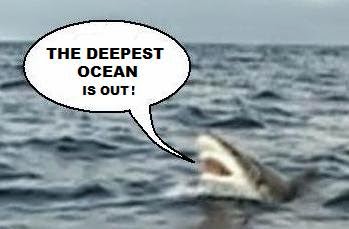
So it all started when I watched Deep Blue Sea
 .
. I’d hoped to see more done with the sharks. Special effects have come a long way since Jaws
 , so I was disappointed that the sharks, once again, were just the people-eating baddies who were all offed by the end. On the subway a day later, I started thinking about what a different kind of shark story might be like.
In my mind’s eye, I saw a large deep pool as if I was looking down into it from above. A plank stretched across the pool and a little girl stood at one end of the plank. The shape of a shark glided through the water just below her.
Then she ran over the plank to the other side of the pool, and when the shark took off as well, I knew they were racing. Also, it beat her every time.
A huge predator and a human would need a good reason to be in close quarters, tolerating each other or even working together. But what if the human had a mental bond with the shark?
I didn’t want the shark to have anything beyond its natural intelligence, though. It would never be Lassie-with-fins, which meant the human would have to work that much harder to understand, protect and control it.
Unlikely that such a psychic link would have just sprung up out of the blue. So there would have to be some sort of organization which found the sharks, developed the mental abilities and fitted the people out with everything they needed.

Then I remembered Denalay. When I first drew up the world of Eden, Denalay got barely a couple of lines in my notes. It didn’t have Dagre’s technology or Iternum’s powerful magic. There were a few dozen islands off its shores, so I decided the Denalaits were at war with the pirates who’d claimed those islands and left it at that.
Now I thought: what if people used their sharks to fight such a war?
Pirates and sharks were two corners of the triangle, and the apex arrived when I watched Master and Commander: The Far Side of the World
 . That movie made me fascinated with ships, and I had my story. The hero was the captain of the ship. The heroine was a shark-bonded secret agent—in fact, she was once the little girl who’d run races with her great white—and they were ordered to work together to free prisoners taken by the pirates.
But he never expected to fall in love. And she never expected anyone like him.

The Deepest Ocean
, a sharkpunk romance, was released by Samhain Publishing today. Read the first chapter on my website, but fair warning… you might not be able to stop at one.
Tweet
Thursday, March 27, 2014
Snow White and the Huntsman


I saw Snow White & The Huntsman
for the first time a few days ago, maybe because I had a craving for Game of Thrones. Unfortunately, this was like wanting a slice of warm apple pie topped with a scoop of ice cream, and getting an apple core to nibble on.I’ll start with the good. The black glass warriors were very cool. Also, I liked the music at the end (the coronation plus the song that plays over the credits).
Other than that, everything was blah. Except for Charlize Theron’s turn as the evil queen Ravenna, who reminded me a little of Jeremy Irons’s evil mage Profion in the similarly awful Dungeons & Dragons
 . It’s as though they realized they were the only elements in the films with the potential to be something other than dull, but regardless, they couldn’t possibly make the films worth watching. So they just went to town on the scenery-chewing.
I can’t even think of Kristen Stewart’s character as Snow White. That character is Kristen Stewart, wearing a perpetually dazed and open-mouthed expression. The sets and clothes are so grungy that her two upper incisors, always on display, look all the whiter in comparison. Even when she’s crowned queen, she just stands there silently with her chest heaving, a tabula rasa to the end.
You can tell they were going for a Joan d’Arc vibe, because to gain her throne she put on armor, led a tiny army and fought the evil queen, but all throughout it I just wondered why no one was wearing a helm. Plus, the resolution of the battle is telegraphed from the moment she meets the titular huntsman. If a man teaches a woman a self-defence move, I guarantee the woman will pull that move out at the last minute to save herself from the villain.
Another problem is that I was never sure what was the source of the evil queen’s power. Shades of Elizabeth Bathory here, since she imprisoned a girl, fed on the girl’s youth and became beautiful while the girl grew old. But apparently there’s a whole village of women who have deliberately scarred their faces (just pale lines down their cheeks, wouldn’t want to gross anyone out) to deter the queen from choosing them. So… she derives her youthfulness from only hot women?
Then she eats a bird’s heart, and of course she wants Stewart’s as well – though why she kept Stewart locked up in the tower for years is anyone’s guess. As for the nature of her power, that goes beyond youthfulness. She’s got Wolverine’s healing factor, Mystique’s ability to change her appearance, super strength and telekinesis (she can raise a portcullis by walking to it). Oh, she also changes into a flock of birds. Basically, she’s all over the place, and no, I have no idea why Stewart was able to kill her at the end. But it was a relief, because that meant the film was over.
The dwarves were awful, the takeover of the castle was unbelievable, and the black glass warriors were utterly wasted. If millions of shards of obsidian fly at you at high speed, you’ll need to be rinsed off the walls. Of course, Stewart’s love interests are barely scratched.
These love interests are the scruffy huntsman (who doesn’t even have a name) and some pretty-boy duke’s son, both of whom kiss her after she eats the apple. I’m sure you can tell which one’s kiss works, but this is a modern retelling, not “Some Day My Unshaven Prince Will Come”, so he just exchanges a few angsty glances with her afterwards.
The queen, a self-made widow, has a love interest too – her brother. Yes, they were going for Jaime/Cersei here, because this film is a patchwork of borrowed concepts covering up a whole lot of nothing. The brother has a silly haircut and that’s about all I can say of him.
If you want to see a strong yet vulnerable princess, watch Pan's Labyrinth
 instead, because Ivana Baquero can act, plus there’s a gripping story and a believable villain to go along with her. Everything this film doesn’t have.
Tweet
instead, because Ivana Baquero can act, plus there’s a gripping story and a believable villain to go along with her. Everything this film doesn’t have.
Tweet
Saturday, March 22, 2014
Five kinds of wings in fantasy
1. Feathered wings
The most common type, though these could be as varied as actual feathers are. Not just in color but in purpose too—there’s a species of bird which has a surprisingly large repertoire of sounds it can make with its wings.
Owls’ wings have also evolved to be nearly soundless in flight—an advantage for hunters.
2. Skin wings
Like bats, whose wings are sensitive enough to detect changes in air temperature and currents, meaning bats can make swift changes to their flight patterns. This would be great for an interspecies romance too—imagine the wings being an erogenous zone.
It’s been a while since I read Anne Bishop’s Daughter of the Blood
 , but her Eyrians might be like this—if anyone can confirm, please let me know in the comments!
 3. Insect wings
I like insect wings the most, perhaps because they look so fragile. The veins running through them help to strengthen them, but it would be interesting to see these scaled up to humanoid size. That would also raise the question of whether the humanoid could hover like a dragonfly, and whether the wings would be concealed in cases when not used in flight.
4. Mechanical wings
The Icarii of Dru Pagliasotti’s Clockwork Heart
 have metal wings, but these can be adapted for defense and attack as well. In the X-Men comics, Archangel’s wings had metal feathers which could be fired as projectiles, and such wings could also have guns mounted on them, similar to rotary cannons or even air-to-air missile launchers. Provided, of course, that they didn’t weigh the flyer down too much.
 5. Magical wings
The angels’ wings in the Diablo video games are great examples of this.

As well as looking cool, the tentacles are also prehensile and can grasp at enemies. I love that dual purpose.
 Tweet
Tweet
Subscribe to:
Posts (Atom)
