Monday, January 13, 2014

Five alternatives to human reproduction


I tried never to miss a Star Trek episode until midway through Voyager. There were several reasons for this, but the show hardly even daring to nudge the envelope was the most important. Especially when it comes to science, Star Trek could have and should have been at the forefront.

And an alien giving birth from the back rather than the front… just did not quite cut it for me. Not when there are so many more unusual methods of reproducing.

1. Parthenogenesis

The women in David Brin’s Glory Season don’t need anyone else’s genetic input for conception, except during a certain time of the year—the titular season. During this time, they can choose to mate, though of course the children produced in this way are likely to be treated differently from those conceived in the more common method.

Suzy McKee Charnas’s Motherlines is similar; the all-female society of the Riding Women would have died out long ago if the women weren’t able to give birth to genetically identical daughters, maintaining their ancestral Motherlines.

The problem that Charnas illustrates in the novel, though, is that such a society won’t have much variation (unless mutation is much more frequent than it is in real life). Hybrid vigor will be unheard-of, and a population without genetic diversity will be that much more vulnerable to infectious diseases.

And it will be that much more difficult for people to be individuals when it comes to thought or belief or behavior as well. If identical twins are sometimes dressed alike, given similar names and expected to do the same things, imagine what it’s like for girls who know that they are doppelgangers of their mothers and grandmothers, all the way back to the first generation.

2. Mitosis

There was an Outer Limits episode where an astronaut, after exposure to something mysterious in outer space, started budding off an extra finger from his hand. He soon realized that this was just the first part of a whole new body—in other words, he was slowly but surely producing another copy of himself.

Mitosis, like parthenogenesis, doesn’t result in as much genetic diversity as sexual reproduction does, though this isn’t necessarily a bad thing if the parent copy has valuable but recessive traits that might be lost otherwise. It could also be much more convenient — look at how hard animals (and people) work to find suitable mates.

Not to mention that budding, a la yeast cells, might be a whole lot less painful than giving birth.

3. Prions

In real life, prions scare me as much as they fascinate me. There’s something insidious about strands of protein (which technically aren’t even alive) gradually corrupting the normal proteins in your brain. But to take this concept a few steps further, what if people could change others into copies of themselves?

As a long-term method of reproduction, this would carry the same risks as mitosis or parthenogenesis, but as a short-term deal, it could have some very interesting uses. I’m imagining a hostage crisis situation where the terrorists don’t realize is that one of the hostages is a prion, and being exposed to her is altering them by the hour.

4. Egg-laying

I like the indifference of most fish and amphibians — lay eggs, wait for them to be fertilized, go on with life. Of course, this is a viable strategy because they produce offspring in such huge numbers that the death of most of them isn’t a tragedy or even a problem.

Though that could apply to a lesser degree with a humanoid race as well. If each female produced, say, half-a-dozen offspring each breeding season, she wouldn’t need to raise them all to adulthood. She could instead abandon them to compete over limited resources, such that only the strongest survived. And if it didn’t, oh well, there would always be next year.

For this to work, though, egg-production, fertilization and any necessary gestation shouldn’t demand too much of a female. In mammals, so much of the female’s resources go into developing the young that naturally fewer of them are born, and those are nurtured and protected. It doesn’t make reproductive sense to devote nine months and one’s physical health to producing a human infant, only to drop it by the wayside.

Unless someone else is prepared to bring it up, which is a whole ‘nother reproductive strategy a la the cuckoo, and developed perfectly in Bernard Taylor's brilliant but out-of-print horror novel The Godsend.

5. Hive insect reproduction

I remember when I first learned what exactly worker bees — the uniformly female, non-reproducing members of the hive — get out of this arrangement. Bee genetics are such that, by allowing the queen to devote all her time to egg-laying, workers actually pass on more of their genes.

If a worker bee mated and laid eggs, her offspring would share 50% of her genes. But when she helps the queen to do the same thing, the queen’s offspring — the worker bee’s sisters — share 75% of her genes. Therefore, it makes sense for the worker bee to want more sisters, rather than children.

As a result, this is a very viable reproductive strategy and I wouldn’t mind using it at all (as long as I was one of the workers, because being stuck doing nothing but producing child after child is not my idea of a good time).

Thursday, January 9, 2014

Christmas present!


Yesterday my friend Godfrey arrived with a large parcel, which he said was a Christmas present for me. You know, to make up for the large, beautiful, handmade, solid wood bookcase that wouldn’t fit down the steps.


"Wow, Godfrey," I said, "all your gifts make me look so tiny in the pictures."
Godfrey said he was not even going to dignify that with an answer.

The gift turned out to be a lovely, full-size bat'leth.


Whoa, Marian, watch out for the lights.
It’s all right, because there... are... four... lights!


Today is a good day to die!


I ran to the kitchen to show my landlady, who’s also Godfrey’s mother, my awesome Christmas present. Not being a Star Trek fan, she turned from the stove and got quite the, er, surprise.

“Why did Godfrey give you that?” she said.

“Because he’s a wonderful person.” I struck a dramatic pose with my new bat’leth. “Don’t you think so?”

“Well, of course, but… why did Godfrey give you that? What are you going to do with it?”

“Hang it on the wall. And then if anyone breaks into the house, I can go all Klingon on their ass.”

Needless to say, that didn’t help. I think she might actually prefer the bookcase.

Tuesday, January 7, 2014

Wintergirls


I don’t usually pick up books where eating disorders play a major role, but I read some quotes from Laurie Halse Anderson’s YA novel Wintergirls in a guide called Writing Irresistible Kidlit. The style was intriguing and I ended up buying myself a copy. It’s just that good.

The story begins when eighteen-year-old Lia finds out her best friend Cassie has died. Which would be bad enough, but on the night of Cassie’s death, she called Lia 33 times. Lia didn’t answer, because they’d fallen out by then.

Which would be worse enough, except Lia knows what killed Cassie—her bulimia, and the pact they made when they were close as sisters, to be skinniest together. Lia chose not to eat at all. Cassie took the other route, but both roads are leading to the same place.

Living with her father and stepfamily, Lia hides the evidence of her worsening anorexia from them as she tries to deal with Cassie’s death. Of course things get even darker, since Cassie appears to her at night—a ghost? a product of Lia’s guilt? It’s up to the reader to decide—and Cassie is lonely.

She wipes a snowflake off my cheek. “You’re not dead, but you’re not alive, either. You’re a wintergirl, Lia-Lia, caught in between the worlds. You’re a ghost with a beating heart. Soon you’ll cross the border and be with me.”

As the year deepens into winter, where it’s easier to hide weight loss under layers of clothes, the voices in Lia’s head and everywhere else grow more difficult to silence. That’s when she starts cutting herself too. This part is disturbing to read, written though it is in elegant poetryesque descriptions. Though it doesn’t last long, because the house of cards comes tumbling down.

Finally Lia runs away to the motel where Cassie died, where she has to face her fate—and either give in to it or walk out of the woods somehow.

We held hands when we walked down the gingerbread path into the forest, blood dripping from our fingers. We danced with witches and kissed monsters. We turned us into wintergirls, and when she tried to leave, I pulled her back into the snow because I was afraid to be alone.

This book is filled with vivid, evocative passages like that. At times the prose is stark and bitter, at others a dreamy stream of consciousness. Once or twice it gets repetitive in a trying-too-hard way, but for the most part it’s incredibly effective. Anderson is a consummate stylist, and I loved the fanciful or terrifying descriptions in the story.

I loved the symbolism, too. That ranges from pomegranate seeds to Pandora’s box to fairy tales—especially the kind with glass coffins. Pick it up for the style, but stay for the story. It's an unforgettable read.

Wednesday, January 1, 2014

Happy New Year!


I have a lot of goals for this year.

The major plans are to get a full-time job and to sell at least two manuscripts (am half-way through one already, so that's more than possible).

Minor items on the to-do list include setting up a nice website and planning a little bit of promotion for when my next novel comes out.

What are your writing-related plans? And all the best to you and yours in the year to come!

Wednesday, December 25, 2013

White Christmas


The Great Blackout of 2013.

That's how I'll always remember Christmas of this year, as the time of the Ice Storm and the Branches On The Power Lines. When everything died late on the night of the 21st, and over two hundred and fifty thousand people were left in cold dark houses. The neighborhood looked like a ghost town.

Things are getting back to normal, but I'm very grateful for everything I tend to take for granted. Wishing all the best to the people who worked round the clock to get the city operational again, and to all those still waiting for their houses to be warm and bright again.


And of course, it's a white Christmas. The city is frosted and hung with icicles, snowflakes sifting down from the clouds.


May your days be merry and bright,
And may you always have water, heat and light.


A wonderful festive season to you and yours!

Tuesday, December 24, 2013

The Story of the Christmas Bookcase


A couple of years ago, I went to a friend’s place for the first time. Flanking her large-screen TV were two large, beautiful solid wood bookcases. I wasn’t in the least interested in the TV, but I admired the bookcases and asked her where she had bought them.

She said her father, who was a carpenter, had made them as a gift when she got married. Since it wasn’t likely that my father, who is not a carpenter, would give me a bookcase for marriage or on any other occasion, I decided I’d buy one once I had enough disposable income. I really wanted a large solid piece, because I already had a small one that I assembled from instructions.

One day I noticed someone had left a headboard by the side of the road nearby, and the headboard had shelves. I always need shelves for my books, so I asked my friend Godfrey to help me get it into the basement apartment where I live. While he was doing so, I told him about my plans to get a solid wood bookcase some day. Godfrey, being the dear soul that he is, offered to make me one.

“Ooh,” I said. “Can you do the top in a fretwork design? With carvings of—”

“You’re getting a bookcase,” he said. “Email me the dimensions.”

So I measured the space I had and decided the basement could accommodate a six-foot-tall bookcase. I would need to stand on a chair to reach the top shelf, and it would be so wide my entire Fighting Fantasy collection could fit on one shelf.


Godfrey set up shop in the garage. This is the frame that would be my solid wood bookcase.


Finally the day came when the bookcase was complete, finished and stained. I wanted the wood left unfinished, so it had a beautiful, natural look. And I do mean natural, because one of the shelves had a hole where a knot had fallen out. “It’s a feature, not a bug,” I said, and asked Godfrey to take my picture next to it.


"Wow," I said, "that picture makes me look really tiny."

"News flash," said Godfrey. "You ARE really tiny." Then he called his brother to help him move the bookcase into the basement.


At this point it became clear that although I’d measured the bookcase for my apartment, I hadn’t measured the bookcase for the narrow doorway leading down the steps. Godfrey and his brother lifted and turned and pushed and twisted. But short of breaking through a wall, and possibly having the house (if not my landlady) descend with a roar on our collective heads, that big, beautiful, solid wood bookcase was stuck. It couldn’t go down the steps.


This picture is captioned: "We're gonna need a bigger hallway."


“Godfrey?” I said finally. “For next Christmas, could you make me a coffee table?”

So they moved the bookcase back to the garage and Godfrey said he would build me a smaller one some time soon. Moral of the story: do not look a gift horse in the mouth, but also do not ask for a Shire when you have a Shetland-sized hallway.

Wednesday, December 18, 2013

The Deepest Ocean


Isn't that the most gorgeous cover? :)

Pirates and battles and sharks, oh my. Not to mention hot sex on the high seas. The artist is the award-winning Kanaxa and The Deepest Ocean will be coming to an Internet near you in April 2014. For now I just couldn't wait to share the cover.

Sunday, December 15, 2013

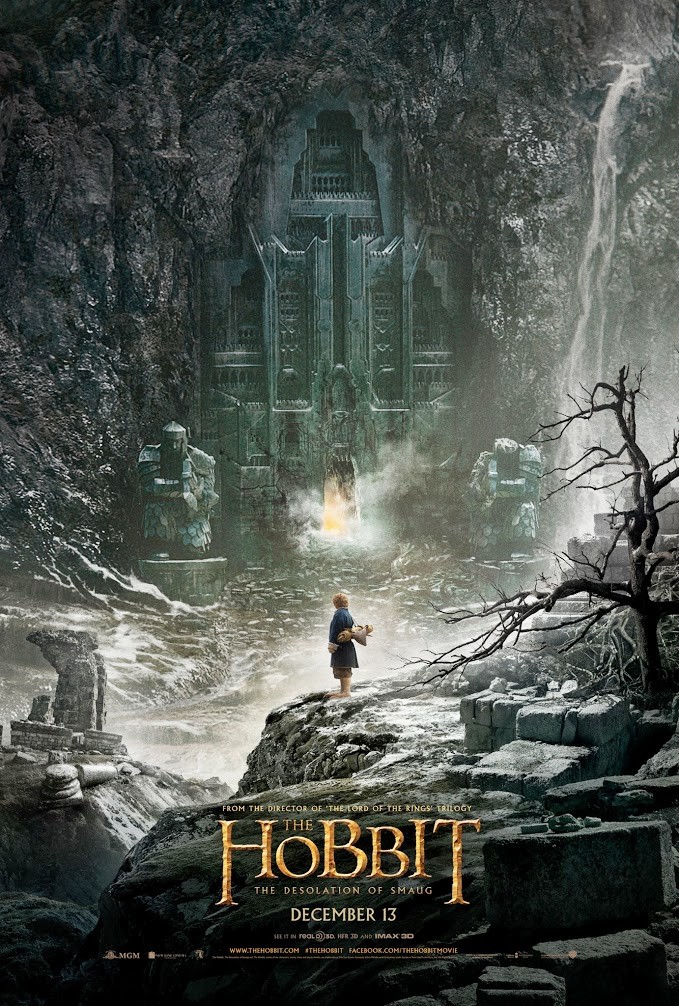
The Desolation of Smaug


My Christmas present to a friend was tickets to The Hobbit: The Desolation of Smaug. My friend’s gift to me was a handmade, solid wood bookcase, but that didn’t turn out as we’d hoped either. I’ll blog about that one soon.

For now, we’ve got movie review sign.

I’ll start with the good. Visually, this is a very vivid film. I loved the locations and all the little details like the huge honeybees in Beorn’s stables.

That was about it, unfortunately. So what didn’t work?

In the book, Gandalf cleverly entertains Beorn with the story of their journey, so he’s more interested in that than in the steadily growing number of dwarves in his house. The film begins with a giant bear chasing them all into the house, but he changes into a man overnight and serves them breakfast in the morning.

That sets the tone. Over-the-top action with cartoon physics is going to be the norm, and characterization falls by the wayside. Beorn, for instance, doesn’t show his caring for his animals by requiring the dwarves to return the ponies, nor does he follow them to make sure they’ll do it, nor do the dwarves grumble at the prospect of trekking through Mirkwood afoot.

Then again, they step into Mirkwood, wander around in a daze like they smoked some very “special” pipeweed and get caught by the spiders. It all happens in one day, perhaps in a matter of hours. I was looking forward to the food running out (imagine the genuine humor that could have resulted), not to mention Bombur falling in the river and having to be carried. None of that. None of the songs, either. But wait, there’s Legolas!

Legolas was never my favorite character in The Lord of the Rings, but there he was at least a canonical part of the Fellowship. Here, he’s shoehorned in to be eye candy for the distaff side of the audience. For the men, there’s Tauriel.

One of my pet peeves in movies is when the producer decides an all-male cast is bad, so he adds a woman who’s gorgeous and kicks ass and falls for the hottest of the males. Basically, she’s a Token Female Action Girl. I’d rather just see an all-male cast, and Tauriel has no personality other than feisty, flawless and fond of Kili, with whom she flirts in an awkward, cliched way.

Kili, for his part, tells her a sob story about how he promised his mom he’d come home. Goodbye, Kili. You were nice in the first movie. I hope you escape soon, and I don’t mean from the elf jail.

Bilbo breaks them all out, but instead of closing the barrels, they all sail along in open upright barrels with Bilbo clinging to the side of one of these. Which would be fine, except Bilbo calls himself “Barrel-rider” when he’s talking to Smaug. When exactly was he riding?

The Orcs chase them. Legolas and Tauriel chase the Orcs. Much action ensues. Legolas actually gets slammed around by the Orc leader on one occasion, but of course he still looks like Barbie’s perfectly groomed younger brother, except for a single artistically placed trickle of blood. Meanwhile the dwarves reach Laketown and meet Bard, your Generic Hero with Adorable Children Who Adore Him.

Then they reach the Lonely Mountain. Bilbo is the only one clever and persistent enough to get them in, and his reward is to be sent to find the Arkenstone (there’s some backstory about how that will unite the dwarven clans somehow). He tiptoes in and Smaug wakes up.

Smaug is the single biggest disappointment in a film crammed to the ceiling with disappointments. He can’t kill one hobbit who’s visible — yes, unlike in the book, Bilbo takes off the Ring and talks to him. He senses the presence of the Ring, yet doesn’t seem at all interested in acquiring it. Then he tries to kill the dwarves and fails miserably.

In fact, the dwarves outwit him at every step of the way, even using his flames to fire up their forges, which make a giant golden statue of a dwarf. It looks like one of those big gold-foil-wrapped chocolate Santas. Smaug stares at it like he’s wondering if it’s a pinata, and the statue dissolves, drowning him in molten gold.

Sadly for Thorin, he hasn’t read A Game of Thrones, so he doesn’t realize that molten gold cannot harm a real dragon. So Smaug swims out and says he’s going to Laketown. Bilbo runs up shouting that those people are innocent. Smaug growls something about revenge, turns and flies off. Presumably he realized the script wouldn’t permit him to so much as singe the beard of a single dwarf in this film — let alone a visible hobbit standing a few yards away and shouting at him — so his only options were either to go to Laketown or to sit around in the Lonely Mountain until a handful of dwarves ate him.

And there the film ended. Thanks be to Eru.

Oh, Gandalf. I almost forgot about him, which is pretty easy to do. He had a major role in the first film, but here he just seems to be at a loose end until the Necromancer captures and imprisons him, like Saruman did in The Fellowship of the Ring. Radagast and his bunny-sled show up for a cameo, but he doesn't do anything either.

This film shows the results of trying to stretch a children’s book out to cover three movies. It’s mostly action, action, action, with none of the camaraderie of the first movie. The dwarves don’t tease Bilbo or joke with each other, and there’s no point in Smaug roaring, “My wings are a hurricane and my breath death!” if he can’t actually do anything except let the dwarves make a fool out of him. Finally, one question. How does Thranduil have both long flowing white hair and eyebrows like Ugly Betty’s?

Friday, December 13, 2013

Be A Sex-Writing Strumpet


What I like most about Stacia Kane’s Be a Sex-Writing Strumpet is that it desensitized me. Completely and utterly popped my mental cherry. After you have read the word “cock” a hundred times, even a Catholic upbringing in a Muslim country can’t make you feel awkward about your sex scenes.

Of course, there’s much much more to the book than that. But the most important thing about it, for me, was that it got me over that hump. No pun intended.

The book is a collection of 24 essays originally published on Stacia’s blog, and although I believe they’re still there, I wanted a copy in physical form. Plus, someone who writes such helpful material deserves to have her book bought. So I got a copy for Christmas last year and it was the best present ever.

I also like how sex-positive this book is. It might seem really obvious that a book with this title would be pro-sex scene, but I’ve come across a lot of writing advice urging people not to describe sex in any detail. Fade to black, summarize, describe it in terms of elegant metaphors, but don’t mention body parts and all that crude unpleasant stuff.

Well, if you want to write a hot or erotic romance, you won’t get very far with that approach. Instead, Stacia shows how to keep the sex scenes an integral part of the relationship and the story—while still being explicit and spicy. The essays even include lists of different words for the sex organs, which was really helpful. It was the first time I’d seen such a list presented seriously, instead of in an amusing collection of purple-prose terms from romance novels (not that there isn’t a time and a place for that too). Plus, I like the discussion of graphic vs. mild and how this needs to be reflected in the story as a whole.

The mechanics of sex, the tone of the writing, even symbolism—it’s all covered here, with detailed examples from Stacia’s work to illustrate points. I think my favorite was the list of unusual places her characters have had sex, because those inspired me to try to be more creative.

If I had a complaint, it would be that this book doesn’t cover enough. I would have liked more discussion of menages, BDSM, etc. A few less-than-positive reviews on Amazon also mentioned the style, which is very breezy, informal and personal (i.e. there are several mentions of Stacia’s preferences in sex scenes, which works for a blog but not so well for a book). But on the whole I enjoyed the book—and I keep it on hand if I ever need help with a sex scene.

Wednesday, December 4, 2013

Hair in fantasy


“Give me a head with hair,
Long beautiful hair,
Shining, streaming, gleaming, flaxen, waxen hair…”
Hair


Hair is ubiquitous. It crops up in mythology and fairy tales, it appears in a hundred different colors, styles and permutations, and I don’t think I’ve read a romance which didn’t provide at least some mention of it. It’s a source of power, a mark of heredity and one of the ways to spot a Mary Sue—her hair is likely to be overpretty or overdescribed. Usually both.

Colors

Minus Clairol, hair occurs in a small range of hues—blond, red, brown, black, grey and white. There’s a lot of room for variation within these colors, but in a fantasy characters can have Ramona Flowers hair with streaks in it—if there’s a good reason for them to have such hair.

Unusual colors might also affect how seriously the characters are taken. If everyone has hair like Rainbow Brite’s horse, the story might come off as a parody. I’d pick just one out-of-the-ordinary color, or at the most two (say, different colors for men and women).

As for natural streaks in hair, there’s a genetic condition which produces this – Waardenburg syndrome, which also causes mismatched eyes. A group of characters distinguished by a white streak in their hair is the Mallen family of Catherine Cookson’s novels, beginning with The Mallen Streak.

Styles

Hairstyles are a good way to show people’s occupations (monks, soldiers and prostitutes will all wear their hair differently) or age. For instance, girls wear their hair in braids but ladies put their hair up. Complicated styles might also be a sign of social status, because only rich people would have the time or the luxury to have their hair teased into various shapes a la Queen Amidala.

And in A Game of Thrones, Dothraki men braid their hair and cut it off when they lose a fight—so the longer a man’s hair is, the better.

Adornment

People can wear pretty much anything in their hair, and often do. Ribbons, flowers, jewelry, chopsticks, berries, seashells, cakes of scent (in a hot climate, these will melt slowly) and even stuffed birds.

This is a good way to hint at social status too. At the start of Jean Rhys’s Wide Sargasso Sea, Antoinette’s braid is bound with string, but later on it’s tied with red ribbon, to show that her family’s fortunes have improved.

Power

Samosn’s hair supposedly gave him great strength as long as it wasn’t cut. Though now I’m wondering if “hair” was a euphemism for something else.

And the gift Galadriel gave Legolas was a bow strung with a strand of hair. The color of hair could also be an indication of a person’s ability, though it might be best not to go for the cliché of fire-mages having red hair.

Finally, what’s your favorite hair color? I like black or brown for most of my characters, but the one which most fascinates me is red, especially if the person has green eyes. To me, that’s about as exotic as you can get.