


Sunday, February 26, 2012
Why I will not review your book
I get occasional emails from writers requesting reviews. Although I read nearly all of these, my time for the past few months has been very limited. Even now that school and placement are officially over, I'm catching up on a lot of things, including a TBR pile, so I'm extremely picky about what I request.
Fortunately (for me, that is) the vast majority of the emails make this an easy decision.
So I came up with a checklist of things I've seen that mean I won't be requesting the book. Several of the examples, by the way, are from actual review requests. If any writers hopeful for a review are reading this, please ask yourself if your email contains
___ an attachment?
___ a copy-and-paste of a press release?
___ something that shows you haven’t read my blog, e.g. “Since you enjoy reviewing political thrillers…”?
___ white text on a black background?
___ several errors, e.g. “Set in , this book tells the story of a serial killer and his murderous rampage through this sleepy country town”? I scrolled down to see who had released this and read “Publisher: Press”.
___ anything that suggests the book was rushed into print, e.g. “I decided to self-publish my book so I didn't need to wait for anyone else to like it or shop it around"?
___ grandiose prophesies, e.g. “This book will be a bestseller”?
___ a claim that your book was top in its sub-sub-genre on Amazon’s free Kindle best-selling list both yesterday and today?
___ a bit too much information upfront? A recent email began: “Marian, Raped at the age of seven, I was a lost and lonely child.”
___ any suggestion that the author is a little too close to the book for me to risk providing an objective review? In the email referred to above, the novel was about a seven-year-old who was raped. I'm very hesitant to comment on anything which seems like self-therapy for the author. Plus, I’ve already had the experience of pointing out something that seems unrealistic, only to have the author claiming it was possible because it happened to her.
___ requests for something I can’t provide, e.g. “I need your help to make my dream become a reality”? I just run a blog here.
___ too many rhetorical questions? One email concluded with, “Will Rod be able to save his family from the clutches of the evil Terry and his own greedy sister-in-law? Will Rod be able to save himself?” Given that the rest of the book description barely even mentioned Rod, I had no idea (or interest).
___ claims that something which is common to most books of this type is unusual about your book, e.g. “The story is developed through several intertwining plot lines that unfold through the actions of multidimensional characters”? Well, that certainly sets it apart from the novels with a single plot line which is uninfluenced by the actions of one-dimensional characters.
___ a description of your book as straddling three or more genres, e.g.. “New Science Fiction Novel Is Part Mystery, Part Thriller, And All Adventure”? This is the literary equivalent of turducken.
___ cover quotes without names appended to them? I have to assume you called your own book “a work of dark genius”.
Tweet


Thursday, February 23, 2012
Fighting Fantasy blogs

Fighting Fantasy role-playing gamebooks were a phenomenon of the eighties, but dwindled in popularity with the rise of video games. Still, retro sometimes comes back into fashion—several of the original gamebooks have been reissued by Wizard Books—and Fighting Fantasy remains popular among a lot of people who grew up in the eighties and fondly remember rolling up SKILL and STAMINA scores.
Myself included, of course. I have the entire collection—some of the books I bought over fifteen years ago, and purist that I am, they’re all the original releases. Recently, though, I found a couple of bloggers who are playing through the books and describing the experience, including the incongruities of the stories, the amazing number (and type) of meals you have to eat and every time you die.
The latter is one of my favorite things about the series, of course. The more sophisticated the books became, the more elaborate the deaths (or non-victory adventure endings, i.e. more or less the same thing).
Dan of Fighting Dantasy tackles every book in the series. The moment I read this ending to his City of Thieves
 adventure I knew I would enjoy his blog.
I had no food either, having traded it all for a silver arrow.
So when a boy came up to me offering to sell me either plums or apples, I was ecstatic. He recommended the plums, and knowing this town pretty well by now I chose the apples, and they were a bit off, doing a single point of stamina damage. Problem: I only had one point left.
I was killed by an apple marginally past its use-by-date.
Then there’s Sword of the Samurai
 :
:Next thing we know, we meet a forty-foot centipede, which I assume must've been common in medieval Japan...? It bit off Moichi's arm, and no amount of food was going to fix that, so I felt justified (but not exactly honourable) in not giving him any. If he needed food that badly, he should have bought his own.
The other blog is Turn to 400, which is much more detailed and snarky.
Somebody needs to let these guys know that when it comes to last words, pithiness is what gets you over. You shouldn't be glancing at your wrist-watch during a guy's dying words. You shouldn't start wondering what might be for dinner. You shouldn't have to interrupt to clarify whether the man is, in fact, actually dying at all, or whether there might still be enough time to drag him down off the mountain or invent all of modern medicine.
I can’t wait for the author to get to my favorite book, House of Hell
 .
.You can also check out back-issues of the Fighting Fantazine here - they’ve got mini-adventures, interviews with authors and artists, humor columns and much more. Enjoy (and don’t drink the white wine)!

Tweet
Monday, February 20, 2012
Final rotation
This was the Chemistry rotation, and it left me so burned out that I haven’t even felt like talking about it until now.
Imagine you’re working in a fast-food restaurant. You have to cook the burgers, pour the drinks, operate the cash register and handle the drive-through traffic. At lunch hour. Oh, and if you get any of the orders wrong, someone could die. It was a bit like that.
Chemistry encompasses more tests than any other department, which meant a huge number of samples to process. Like Hematology and Transfusion, Chemistry operates around-the-clock, with huge analyzers that take dozens of specimens at a time and which are constantly working.
Yet it’s not as simple as feeding in the specimens at one end and collecting the results at the other. The analyzers need regular (and sometimes constant) maintenance, cleaning, calibration and topping-up. If one breaks down, it can cause an serious backlog. And as well as running these, the technologists need to do a number of other tests which are few enough in number that they can be handled manually—analyzing sweat samples for cystic fibrosis, running the flame spectrophotometer, pregnancy tests, fecal occult blood tests and so on.
Most of the time, though, I felt as though I was just trying to keep my head above water—or above the flood of specimens. There was no time for the technologists to ask me questions about the theory behind what we were doing. Chemistry can be interesting, and I never found it particularly difficult in college, but towards the end I was so exhausted I was just counting off the days.
And after it was over, there was the qualifying exam to study for. That was on the 16th, and even if I had wanted to get a full night’s rest before it, I was too tense. I probably had reason to be, since the exam was tough, and I honestly have no idea how it will turn out. CSMLS will let us know in four to six weeks, so that’s another month of worrying I have ahead.
Though at least now I can start looking for jobs. For the past nine months I’d been working part-time in a bookstore owned by a psychic, but I quit that when it got to be too frustrating – here’s a link to the story. Things have got to get better from here.
Tweet
Thursday, January 5, 2012
Characters whom everyone loves
Recently I read Kathleen E. Woodiwiss’s The Flame and the Flower
 , one of the grand old novels of the romance genre. One reason I didn’t enjoy it was the near-universal adoration of the heroine by the other characters, and that made me think of characters loved by everyone.
1. Give them a reason for this.
If it’s not obvious to the readers why so many people love this character, it’s going to be difficult for them to share the feeling. Worse, it’s likely to turn them off. In real life, people who are very obviously beautiful have their admirers, but they may also have detractors or people who just don’t like them, and that’s not necessarily a bad thing.
In fiction, a character will need more than stunning good looks, given that paragraphs of description are likely to be ineffective unless very well written. So such characters should have other qualities, traits, goals or backstories that show why they’re so well liked.
That was something I enjoyed about Richard Adams’s The Girl in a Swing
 . The narrator marries a woman called Karin, despite knowing nothing about her past, and it’s made clear throughout the story that people find her extremely attractive. But it wasn’t until my second read of the novel that I realized Adams never actually said what Karin looked like. He mentions her clothes, but not her hair or height or the color of her eyes.
 So she’s as much of an enigma physically as she is in other ways, but that technique puts the focus on her charming mannerisms, dialogue and actions rather than her looks, and it works very well.
2. Consider not making them the protagonist.
It’s easier to like characters who are near-perfect when they play a secondary role. Gone with the Wind
 probably wouldn’t have been so popular if Melanie rather than Scarlett had been the heroine, and taking such a paragon out of the spotlight nearly always makes them easier to like.
 In Orson Scott Card’s Hart's Hope
 , the Flower Princess is described as the most beautiful woman in the world because she has never told a lie, meaning she’s both morally and physically perfect. People everywhere love her. But she’s not the main character, and she loses her bridegroom, her position, her freedom and her beauty in one day, making her sympathetic rather than saccharine.
3. Don’t make it a moral yardstick.
If all the good characters love the heroine and all the villains hate her (or are jealous of her, or lust unrequitedly after her), she’s going to come off as a Mary Sue. The other characters’ feelings toward the protagonist shouldn’t be a sign of their moral development. No matter how benevolent or cruel people are in real life, there’s sure to be someone who hates or loves them regardless.
4. Give them consequences
What are the consequences of everyone loving you? Maybe the fact that you’re placed on a pedestal from which you can only fall, never rise. Maybe the fact that the people who love you the most can rarely evaluate your skills objectively or give you the kind of tough training you might need to succeed at a task.
Unconditional, unchanging love is like an unconditional and unchanging supply of anything: eventually it loses its appeal. I’d like to read a story where a character had such a powerful charismatic appeal that he or she was universally loved – but grew to secretly hate this.

Tweet
Tuesday, January 3, 2012
Insomnia
This has never happened to me before, but I guess there's a first time for everything.
After lying in bed wide awake for three hours I finally decided it was better to be exhausted but productive than exhausted and feeling like I hadn't accomplished anything into the bargain. So I got up, answered emails, wrote a lengthy review and studied the bilirubin section in my chemistry notes. Chemistry rotation starts today, and will probably be fueled by vast quantities of this:

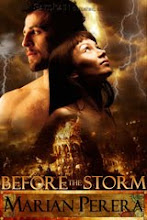
On the bright side, though, I have two reviews of Before the Storm

to share, and that's a great way to start the year! The first is from Books Without Any Pictures:
“Before the Storm” contained a lot of strong female characters who rode into battle, blew shit up, and wore chainmail under their dresses.
I love it when women dress prettily and pack heat at the same time.
The second is from the Crazy Bookworm, and this blog is THE go-to place for current YA (just looking at all the lovely covers makes me want to read those rather than chemistry notes).
I have never been much of a Fantasy reader. I have only read a few of them, but could never really get into the genre. However, Before the Storm was a completely different story!... Marian Perera DID NOT skimp out on the Characters, in fact, I believe they were the strongest qualities about the book. I adored Alex, she was such a unique and feisty character.
I think characterization is vital too, and I work hard at that, so it's great to read this.
Off to get ready for work now.
Tweet
Friday, December 23, 2011
Microbiology rotation done!
This is the first day in over a month where I’ve felt relaxed.
It’s been the best month clinical-rotation-wise, but it’s also been the most stressful. This is the end of my microbiology rotation, and microbiology is my favorite discipline. My dream day job would be in a micro lab.
So of course I put pressure on myself to do well, to learn fast and to know as much as possible. I did learn a great deal - there was a lot of new information on bacteriology, antibiotics, mycology (the study of fungi) and so on – and the technologists asked a lot of questions to make sure I knew what was going on. The end result was that I did enjoy the rotation, but I also felt as though I was under a microscope myself. I can only hope I made a good enough impression.
On top of that were my two part-time jobs and the need to study for a qualifying exam that’s less than two months away. So I came home exhausted every day – my apartment looks as though it’s been burglarized, with stuff lying everywhere – and I was way too tired to blog.
They let us have today off, which is a great relief. I’ll still be going to the hospital, of course, but that’s for one of my part-time jobs rather than lab work, so it should only be a few hours.
So, what goes on behind the scenes at a microbiology lab?
The lab processes hundreds of specimens on a daily basis. As well as receiving samples from people who are sick, the lab tests screening swabs (to make sure in-patients aren’t bringing any superbugs into the hospital), water samples, and even medications from the pharmacy department. Everything is sent through the front end, where it’s entered into the system and given an accession number.
The people in the front end work like maniacs as a result.
After that the specimen, like a piece of luggage in the airport, goes on to its final destination. Depending on what the specimen is or what the doctor has asked for, it could be sent to the blood bench, the virology department, the screeners, etc. The bottles of blood are incubated and rotated in a large analyzer that looks like an enclosed wine rack. Technologists at the different benches put the specimens on various agar plates to see what grows.
It is always good when nothing does, not only for the patient but for the technologist. If something does grow, that’s when the train of thought speeds up. Is the bacterium a pathogen (disease-causing agent) or just a contaminant which sneaked in somehow? If it’s a pathogen, what tests need to be done to confirm its identity? If it’s a pathogen, is it present in sufficient numbers to report?
If technologists reported everything they saw, they’d be either dead from exhaustion or fired for incompetence.
Once the pathogen has been identified, it moves on to the antibiotic testing bench. I moved too, and spent a week learning more about antibiotics than two semesters in college taught me. What antibiotics is the pathogen resistant to? Is it a superbug? What antibiotics can be reported? The analyzer may tell you that the E. coli is susceptible to tetracycline. But if you report that and if the patient is seven years old and if the doctor doesn’t know any better and prescribes tetracycline, the patient will go through life with discolored teeth as a result.
You have to know a whole lot more than the machines and the computer system (and sometimes the doctors), in other words.
I didn’t get a chance to see the virology department, but that was the only disappointing thing about my experience. I even identified a fungal species correctly on my last day, which was all the better because that was the only day we spent on mycology. But it’s great to come home and rest, to have a long relaxed breakfast rather than bolting it with one eye on the clock and to know I’ve got the whole of the Christmas holidays before the chemistry, the next and final rotation.
It’s pretty good to be blogging again too. :)
Tweet
Tuesday, November 15, 2011
Blood bank
So now I'm in the blood bank, AKA Transfusion Science. Between this, my two part-time jobs, studying for the CSMLS exam in February and doing revisions on During the Fire, I've been too busy for anything else.
But as well as my blog being overdue for an update, I like to describe the behind-the-scenes work in the hospital. So... blood bank.
When a patient needs a transfusion, a sample of their blood is sent to us for a type and screen. Most people know their ABO and Rh type (e.g. A negative, O positive), but pregnancy and previous transfusions can complicate matters. Being exposed to foreign antigens - and yes, a baby's can be treated as foreign by the mother's body - makes a patient's immune system react by producing antibodies, and this can lead to a bad reaction if they're given blood that hasn't undergone further screening. That's another thing the blood bank checks.
Then the blood can be further treated (e.g. irradiated to kill donor white blood cells which might otherwise attack the recipient) before being labeled and allocated via the computer system. It took me a good few days to become at all familiar with the computer system where everything that happens to a unit of blood has to be documented. I've never worked anywhere where accountability and cross-checking were more important.
Which is understandable. Issue the wrong unit and a patient could die. That's another thing the blood bank does - investigation of transfusion reactions, when a patient has a bad response to the blood they've received.
The Transfusion department also handles blood products (platelets and plasma) and recombinant products like clotting factors for people with hemophilia. It's a fascinating place to work, and the staff are friendly. The teaching tech assigned to us, though, is a bit of a prankster. One day I was in the walk-in freezer, getting some immunoglobulin to be issued to patients. The light switch is outside the freezer, so he crept up and turned it off.
I was so startled I swore. Naturally, he thought that was hilarious. Thankfully I didn't drop the bottles of immunoglobulin, which would have been somewhat less hilarious.
Off to work now.
Tweet
Friday, November 4, 2011
The Full Monty

It’s easy to imagine the high-concept for this film: “Six unemployed steelworkers become strippers”. But that short-changes The Full Monty
 , because it’s much more than a bawdy comedy. There are a lot of films I enjoy, but only one so far where I’ve shelled out for the DVD, and this is it.
 The films begins after Sheffield’s steel industries have collapsed, and months of unemployment have left most of the former steelworkers depressed and cynical. Gaz can’t afford child support, despite his various schemes for earning a quid here and there, while his best friend Dave is physically as well as financially impotent. Dave’s wife, now the family’s breadwinner, feels he’s given up on her as well as on himself, so she goes out for the night to watch the Chippendales perform.
But that gives Gaz an idea. “Them buggers can, we can,” he says, and proceeds to round up a reluctant handful of his fellow unemployed.
Gaz is the linchpin of the film, a wonderfully drawn and acted character. In private he’s unsure of himself; with the rest of the gang, he’s driven, confident and energetic. He’s engaged in a constant juggling act as he tries to keep everyone more or less doing as he wants – all so he can continue to see his son.
The other characters are great too, though. Gerald, their ex-foreman, still hasn’t told his wife that he’s been unemployed for six months, so every day he dresses in a suit, takes his lunchbox and heads out to the Job Centre. Lomper is pale, skinny and suicidal – the scene where Dave fixes Lomper’s car’s engine and smoke immediately begins to fill the car’s interior is hilarious. Guy can’t sing or dance, but with his physical attribute, he may not need to. And Horse can dance, but needs a hip replacement. “Me breakdancing days are probably over, but there’s always the funky chicken,” he says.
As if six of the unsexiest wasn’t a recipe for success, Gaz is then put on the spot by a woman who asks why anyone would pay to see them instead of the Chippendales. “This lot go all the way,” he claims, giving the film its title and nearly scaring all the others into hanging up the G-strings for good.
But as they exercise and rehearse together, deal with their various problems – which eventually involve the police – and work up the nerve to take it all off, they slowly start to regain the friendship, confidence and masculinity they lost along with their jobs. For a comedy, this film touches on some surprisingly deep issues. It made me care, it made me laugh and it made me buy the DVD. Recommendations don’t get much better than that.
Tweet
Sunday, October 30, 2011
From blood to worse
The Hematology rotation ended on Friday.
Two-thirds of the way gone, and I feel as though I’m running on empty. Here’s why.
Last week our clinical coordinator at the hospital informed us that there were a couple of part-time positions open at another department (Molecular Genetics), for students to help with administrative work. Date-stamping reports and sending them out, filing and photocopying and so on. I applied and got one of the positions, which was great in terms of getting a foot in the door.
It also pays five dollars more per hour than my Saturday job at the used-book store, so that’s good as well. I worried a lot about my finances after paying the final tuition fees. This job is going to help so much in that regard.
The problem is that after putting in eight hours at the lab and then two more hours of work, there’s nearly an hour’s commute home and I drag myself into the apartment, wiped out. Way too tired to blog, which is why this has been quiet lately.
Part of it was also because last week I was running about trying to get my immunization records in order to fulfil HR requirements, so that was exhausting too, and I ended up catching a bad cold that knocked me out for two days. But I’m feeling a little better now, and hoping that I can somehow survive the frenetic schedule until the end of January. I also really need to study more and keep up with writing.
Still, at least I did OK with Hematology. The next rotation is Blood Transfusion, so I’ll be working with the same substance but running different tests. And on that note, in Japan, it’s a popular belief that blood type has something to do with personality.
Forced to quit after barely a week as Japan's reconstruction minister for remarks deemed offensive to victims of the March earthquake and tsunami, Ryu Matsumoto had an unusual explanation for his behavior -- his blood type.
"My blood's type B, which means I can be irritable and impetuous, and my intentions don't always come across," he said Tuesday after his resignation.
If your intention is to show responsibility and remorse, obviously not.
Tweet
Sunday, October 23, 2011
Deserts in fantasy
I grew up in the Middle East so I have a soft spot for deserts and will read almost any fantasy novel which features them. My favorite act in Diablo 2 was also the second one, which is set in the deserts of Lut Gholein.
Creating a distinctive desert can be a lot of fun, too.
1. Terrain
Deserts don’t have to be vast stretches of sand dunes. They could be rocky instead, with great spires of weatherworn stone that fall away into deep canyons, or great expanses of pebbles which make ground travel slow if not hazardous. As for the sandy deserts, sand can be simply sand, or it can be granulated chemicals, salt or the crushed remains of bones. It could be red sand, green sand (like the poisonous desert in Stephen King’s The Eyes of the Dragon
 ) or white sand.
And in Dune
 , there were drum sands which amplified the sounds of travelers’ footsteps and attracted sandworms.
2. Magical features
I’ve blogged before about unusual physical phenomena, and a desert would be a great place to display some of these. Walls of whirlwinds or sentient sands could provide conflict and action as well.
3. Flora and fauna
It’s fun to imagine the kinds of creatures who have adapted to life in the desert. Dougal Dixon’s After Man
 and The New Dinosaurs
 are treasure troves of such imagination, but even existing fantasy creatures can be adapted for a desert life. Unicorns might be black—and partially metallic—so that they can use solar power, for instance.
4. Humans and humanoids
If there are settlements of people in the desert, how do they cope with the heat and the scarcity of water? Are they nomadic, moving from oasis to oasis, or have they simply adapted to the point where they don’t need to drink more than a handful of water per day (and if so, there should be other physical and social modifications).
A great book set in this environment is Colin Wilson’s Spider World Book One : The Desert (out of print, though, and I couldn’t even find a copy on Amazon). The humans, who live in burrows, use giant slave ants to gather water and a tamed wasp to hunt—the wasp injects prey with a neurotoxin. Of course, the humans become the hunted when their spider overlords drift over the desert on silken aircatchers, mentally searching for prey far below.
Deserts can be—and probably should be—as varied and dangerous in fantasy as they are in real life.
Tweet
Subscribe to:
Posts (Atom)
